Red Yeast Rice for Cholesterol: Evidence, Safety, and How It Compares to Statins
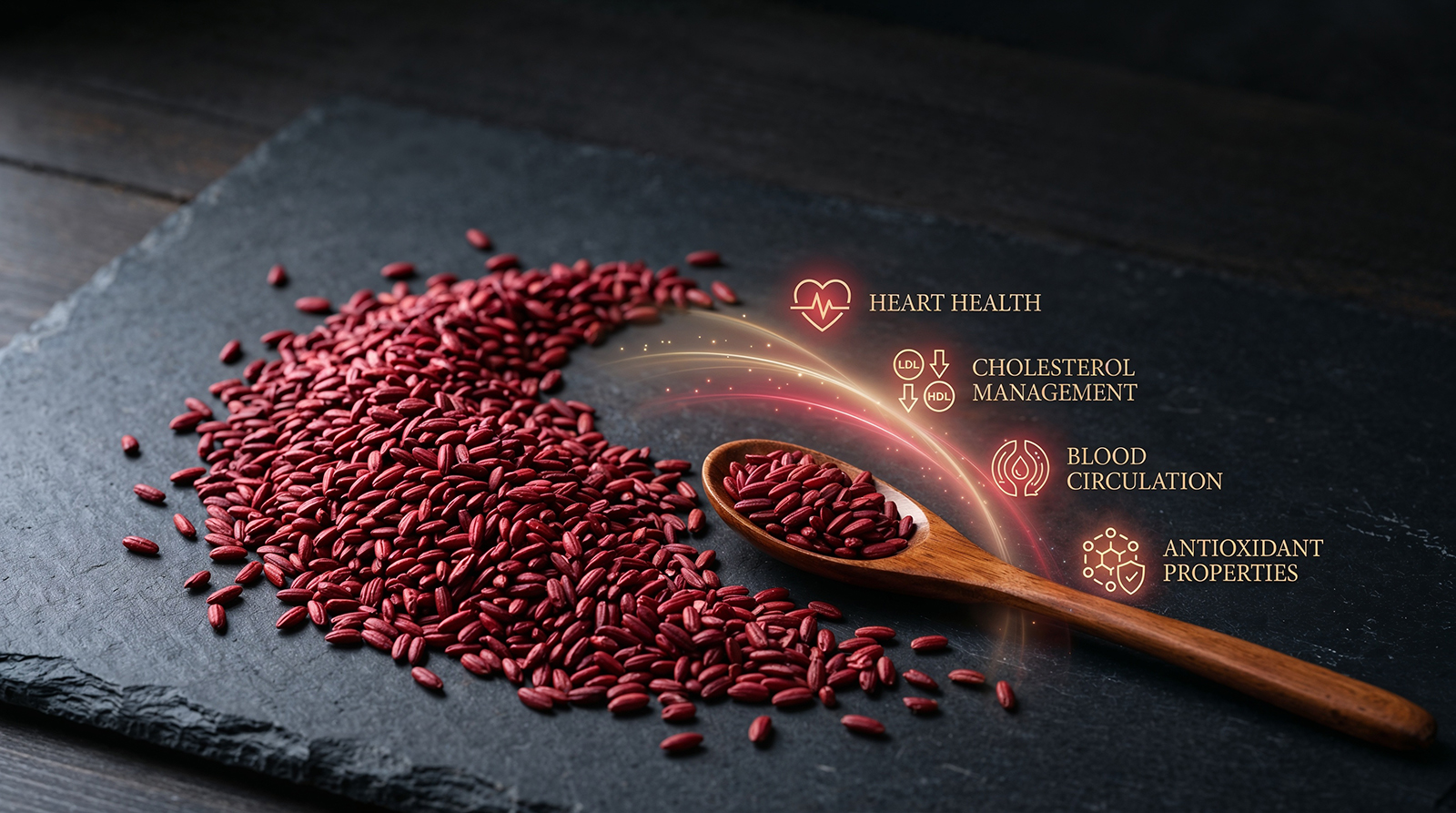
Red yeast rice for cholesterol has more clinical evidence behind it than almost any other natural supplement — because it contains monacolin K, a compound chemically identical to the prescription statin lovastatin. That makes it genuinely effective and genuinely requires the same informed approach as pharmaceutical statin therapy. This guide covers what red yeast rice actually does, the clinical evidence, the safety considerations that matter, and where it fits in an integrative cholesterol management protocol.
Red yeast rice is produced by fermenting white rice with Monascus purpureus — a yeast that generates a family of compounds called monacolins.
A meta-analysis of 13 RCTs found red yeast rice reduced LDL cholesterol by an average of 24 mg/dL — comparable to low-dose prescription statin therapy.
Red yeast rice depletes CoQ10 through the same mevalonate pathway mechanism as pharmaceutical statins.
The monacolin K content of red yeast rice products varies widely — from less than 1 mg to over 10 mg per capsule — and many products do…
What Is Red Yeast Rice?
Red yeast rice is produced by fermenting white rice with Monascus purpureus — a yeast that generates a family of compounds called monacolins. Monacolin K, the primary active compound, is structurally and functionally identical to lovastatin, a prescription HMG-CoA reductase inhibitor. This means red yeast rice works through the same mechanism as statin drugs: inhibiting the rate-limiting step of cholesterol biosynthesis in the liver, reducing LDL production, and upregulating hepatic LDL receptor expression to increase LDL clearance. The distinction from pharmaceutical statins is one of dose, standardization, and regulatory classification — not mechanism.
Red Yeast Rice for Cholesterol: What the Clinical Evidence Shows
LDL Reduction
Multiple randomized controlled trials confirm meaningful LDL reduction with red yeast rice supplementation. A meta-analysis of 13 RCTs found red yeast rice reduced LDL cholesterol by an average of 24 mg/dL — comparable to low-dose prescription statin therapy. Individual trials have shown LDL reductions ranging from 15 to 35 mg/dL depending on the monacolin K content of the preparation, dose, and baseline lipid levels. Total cholesterol reductions of 20–30 mg/dL and triglyceride reductions of 20–35 mg/dL are consistently seen alongside LDL improvements.
Cardiovascular Outcomes Data
Unlike most supplements, red yeast rice has cardiovascular outcomes data — not just lipid number improvements. The landmark China Coronary Secondary Prevention Study (CCSPS) randomized 4,870 patients with prior myocardial infarction to red yeast rice extract (Xuezhikang) or placebo and followed them for 4.5 years. The red yeast rice group had a 45% reduction in recurrent heart attacks, a 33% reduction in total cardiovascular events, and a 33% reduction in total mortality. This is outcomes-level evidence that very few natural supplements can claim.
Additional Components Beyond Monacolin K
The Xuezhikang preparation used in the CCSPS contained not just monacolin K but also sterols, isoflavones, monounsaturated fatty acids, and other monacolins — which may explain outcomes that exceeded what monacolin K alone would predict. Whole red yeast rice extracts with these co-occurring compounds may be more effective than highly purified monacolin K preparations.
Red Yeast Rice Safety: What You Must Know
Because monacolin K is pharmacologically identical to lovastatin, red yeast rice carries the same safety profile as low-dose statin therapy — not the benign safety profile of most supplements.
Muscle Side Effects
Myalgia (muscle pain) and myopathy (muscle weakness) occur with red yeast rice at similar rates to equivalent doses of lovastatin. Patients who discontinued statins due to severe myopathy are at risk for similar symptoms with red yeast rice and should use it only under physician supervision. Rhabdomyolysis — severe muscle breakdown — has been reported with red yeast rice, though it is rare.
CoQ10 Depletion
Red yeast rice depletes CoQ10 through the same mevalonate pathway mechanism as pharmaceutical statins. CoQ10 supplementation at 100–200 mg daily of ubiquinol is recommended alongside red yeast rice for the same reasons it is recommended with statins — to address mitochondrial energy production depletion and reduce muscle symptom risk.
Citrinin Contamination Risk
Some red yeast rice products contain citrinin — a mycotoxin produced during fermentation that is nephrotoxic (damaging to the kidneys). Third-party tested, pharmaceutical-grade preparations are essential — not all products on the market are adequately screened. Look for products with a certificate of analysis confirming citrinin below detection limits.
Drug Interactions
Red yeast rice interacts with the same drugs as lovastatin: grapefruit juice and grapefruit (inhibits CYP3A4, elevating plasma levels), cyclosporine, certain azole antifungals, niacin at high doses, and gemfibrozil — all increase the risk of myopathy. Berberine, which inhibits CYP3A4, may also elevate red yeast rice monacolin K levels and the combination warrants physician review.
Red Yeast Rice Dosing
The monacolin K content of red yeast rice products varies widely — from less than 1 mg to over 10 mg per capsule — and many products do not disclose monacolin K content. Clinical trials have typically used preparations providing 3–10 mg of monacolin K daily, equivalent to 20–40 mg of lovastatin. A typical product providing 600 mg of red yeast rice extract twice daily (1,200 mg total) delivers approximately 4–8 mg of monacolin K from quality standardized products. Effects on lipids are typically visible at 8–12 weeks.
Who Is Red Yeast Rice Appropriate For?
Red yeast rice is most clinically appropriate for patients with elevated LDL who are not candidates for or who decline pharmaceutical statin therapy, who have mild-to-moderate statin intolerance (not severe myopathy), or who prefer to start with a lower-intensity approach while implementing dietary and lifestyle changes. It is not appropriate as a substitute for statins in very high-risk patients (recent ACS, LDL above 190 mg/dL with familial hypercholesterolemia, established ASCVD with inadequate LDL control) where high-intensity statin therapy has the most robust outcomes evidence.
When to See a Doctor Before Starting Red Yeast Rice
Always consult your physician before starting red yeast rice if you take any medications metabolized by CYP3A4, have prior statin-related myopathy, have liver or kidney disease, are pregnant or nursing, or if your LDL is above 190 mg/dL (which typically requires higher-intensity management). Red yeast rice is not a self-prescribable supplement — its pharmacological activity warrants the same medical oversight as the equivalent statin dose.
The Integrative Cardiology Approach
At Holistic Heart Centers, red yeast rice is prescribed as part of a protocol that includes CoQ10 supplementation, baseline and follow-up liver function testing, lipid panel monitoring at 8–12 weeks, and concurrent dietary optimization. Dr. Druz uses advanced lipid particle testing (NMR LipoProfile) to confirm LDL particle count and size — not just LDL concentration — before and after treatment, ensuring the intervention is achieving meaningful risk reduction rather than just moving numbers.
Frequently Asked Questions
Does red yeast rice actually lower cholesterol?
Yes — red yeast rice reduces LDL cholesterol by 15–35 mg/dL in randomized controlled trials, with cardiovascular outcomes data from a 4,870-patient trial showing 45% reduction in recurrent heart attacks. It works through the same mechanism as prescription statins because its active compound (monacolin K) is chemically identical to lovastatin.
Is red yeast rice safer than statins?
Not inherently — at equivalent monacolin K doses, the side effect profile is similar to lovastatin. The lower monacolin K content of many products means lower intensity effects (and potentially lower side effects), but also lower efficacy. The citrinin contamination risk in lower-quality products is an additional concern not present with pharmaceutical statins. Third-party tested, pharmaceutical-grade products are essential.
Can red yeast rice replace my statin?
For lower-risk patients with mild-to-moderate LDL elevation, red yeast rice with dietary modification is a reasonable non-pharmacologic approach. For high-risk patients — those with established cardiovascular disease, familial hypercholesterolemia, or LDL above 190 mg/dL — pharmaceutical statins with superior outcomes evidence are the standard of care. The decision requires individual risk stratification, not a general rule.
Interested in whether red yeast rice is right for your cholesterol profile
The Step 1 Explore visit at Holistic Heart Centers includes advanced lipid evaluation and a personalized supplement protocol.
Schedule a free strategy call →References
- Lu Z, et al. Effect of Xuezhikang, an Extract from Red Yeast Chinese Rice, on Coronary Events in Patients With Previous Myocardial Infarction (CCSPS). Am J Cardiol. 2008;101(12):1689-1693.
- Cicero AFG, et al. Red Yeast Rice for Dyslipidaemia. Am J Cardiol. 2017.
- Banach M, et al. The Role of Nutraceuticals in Statin Intolerant Patients. J Am Coll Cardiol. 2018;72(1):96-118.
More Articles on Heart Disease
-
Can Diet Reverse Heart Disease?
Read more →: Can Diet Reverse Heart Disease?Heart Disease Diet can contribute to reversing heart disease, particularly when it addresses the root causes of atherosclerosis like inflammation, insulin resistance, and oxidative stress. Clinical trials have demonstrated measurable plaque regression with intensive dietary intervention. However, diet alone may not be sufficient for everyone, especially those with advanced disease, genetic risk factors, or significant…
-
What Causes Heart Disease?
Read more →: What Causes Heart Disease?Heart Disease Heart disease is caused by damage to the blood vessels and heart muscle that accumulates over time. While cholesterol often receives the most attention, the actual disease process is driven by a combination of chronic inflammation, metabolic dysfunction, oxidative stress, and arterial damage. These factors interact to create atherosclerosis, the buildup of plaque…
-
Why Is Heart Disease The Leading Cause Of Death?
Read more →: Why Is Heart Disease The Leading Cause Of Death?Heart Disease Heart disease remains the leading cause of death worldwide because it develops silently over decades, is driven by common modern lifestyle factors, and is often detected too late requiring invasive intervention. The cardiovascular system is uniquely vulnerable to the cumulative effects of inflammation, metabolic dysfunction, and arterial damage. Unlike many other diseases, heart…
See all Heart Disease articles → | Back to Heart Health Blog