Cholesterol management beyond statins.
High cholesterol isn’t just about one number — it’s a signal that something deeper needs attention. We use advanced testing to uncover the root causes driving your lipid imbalances, then create personalized plans that go beyond statins to address inflammation, metabolism, and genetics for lasting cardiovascular protection.

Are you doing everything right — eating clean, exercising regularly, even taking medications — yet your cholesterol numbers refuse to budge? Most conventional approaches to cholesterol management are flying blind, focusing on a single number while ignoring the deeper story your body is trying to tell.
We take a radically different approach. Cholesterol isn’t the enemy — it’s a messenger. When your numbers are elevated, your body is signaling that something deeper needs attention. Our precision cardiology approach, led by Dr. Regina Druz, MD, MBA, FACC, FMCP-M, decodes that message and addresses the real drivers of cardiovascular risk.
Why traditional cholesterol management falls short
For decades, patients have been taught to trust the system like a plane on autopilot: follow the heart-healthy diet, take the statin, check your LDL, and you’ll be fine. But what happens when that autopilot is programmed for outdated coordinates?
Here’s what most doctors won’t tell you: 75% of people who have heart attacks don’t have high LDL cholesterol. Millions are falsely reassured — or wrongly medicated — because we’re measuring the wrong things. While statins reduce vascular events by 25–30%, a staggering 70–75% residual risk remains even among patients taking their medications faithfully. Focusing only on total LDL is like looking at the oil light while ignoring the engine warning signs. It’s not the number that matters most — it’s what’s happening inside your arteries, and why the damage is occurring in the first place.
Cholesterol is a signal, not a disease
Your body doesn’t just have “high” or “low” cholesterol — you have a unique lipid type influenced by genetics, inflammation, hormones, insulin resistance, oxidative stress, and lifestyle. This is your lipidome, a complex operating system that standard tests barely scratch the surface of. Some patients have elevated LDL from chronic inflammation; others from insulin resistance; some carry genetic traits that only express under certain conditions; and many are affected by hormonal shifts. Treating all of these with the same prescription is reactive, not strategic.
Think of your arteries as roads. Inflammation and oxidative stress create potholes. Your body sends cholesterol — like an emergency repair crew — to patch the damage. If damage is occasional, repairs work fine. But if potholes keep forming from poor diet, chronic stress, blood-sugar dysregulation, toxins, or hormonal imbalances, cholesterol keeps arriving, layering on more patchwork until those patches become plaque. The question isn’t “how do we get rid of cholesterol?” — it’s “why is the damage happening in the first place?”
We understand your frustration
If you’ve been struggling with cholesterol issues, you may be experiencing:
- Anxiety about your heart health despite following medical advice
- Frustration that your numbers aren’t improving despite lifestyle changes
- Concern about long-term medication side effects, such as new-onset diabetes with statins
- Confusion about conflicting information on cholesterol and heart disease
- Worry about family history repeating itself
- Exhaustion from feeling like you’re fighting an uphill battle alone
You deserve answers — not just prescriptions. You deserve a partner who will dig deeper, listen to your concerns, and create a plan tailored to your unique biology.
Far beyond a standard lipid panel.
Once we understand your unique lipid type and its root drivers, we can treat strategically rather than reactively. Our comprehensive testing decodes the message your cholesterol is sending.
Advanced Lipid Particle Analysis
Not just total LDL, but particle size, density, and behavior — because small, dense LDL particles are far more dangerous than large, fluffy ones. Two people with identical LDL can carry very different risk.
Inflammatory Markers
hsCRP, MPO, Lp-PLA2, and other markers that reveal whether your arteries are under active attack — often the real driver of risk when LDL looks acceptable.
Metabolic Assessment
Blood sugar, insulin levels, and markers of insulin resistance that often drive plaque formation — and that standard panels don’t capture.
Oxidative Stress & Hormonal Panels
Understanding how oxidative stress and hormonal shifts — especially during menopause or chronic stress — are aging your arteries and shaping your lipid profile.
Genetic Testing
Including Lipoprotein(a), MTHFR, and other SNPs that affect lipid metabolism and clearance — revealing how your genes interact with lifestyle and environment.
Vascular Imaging
Coronary artery calcium scoring and endothelial function testing to assess real arterial health — what’s actually happening inside your vessels, not just on a lab report.
Designed to be convenient
- HeartWell Toolkit™: convenient at-home blood and genetic testing to begin your precision journey — the same advanced diagnostics, collected from the comfort of home.
A personalized treatment plan built around you
Once we understand your unique lipid type and its root drivers, we create a comprehensive, personalized plan that may include:
- Targeted nutrition — anti-inflammatory eating strategies tailored to your metabolic profile, not generic “heart-healthy” advice.
- Nutraceutical support — medical-grade supplements including omega-3s, plant sterols, berberine, red yeast rice, and targeted nutrients based on your genetic profile.
- Metabolic optimization — addressing insulin resistance, blood-sugar regulation, and metabolic flexibility.
- Hormonal balancing — supporting optimal hormone function that directly impacts lipid metabolism.
- Detoxification support — clearing toxin burden that can disrupt cholesterol regulation.
- Stress & sleep optimization — because cortisol dysregulation directly impacts your lipid profile.
- Strategic medication management — when medications are needed, we use them precisely, with the goal of reducing dependency over time as root causes are addressed.
The Heartwell Method™, built on real science.
Dr. Regina Druz pioneered the Heartwell Method™ and the Fit in Your GENES® Program to transform how we understand and treat cholesterol — combining advanced diagnostics with science-backed natural therapies. Her philosophy is simple but powerful: cholesterol is a signal, not a disease.
Precision, not protocol.
- Evidence-based — every recommendation is grounded in clinical research and proven protocols.
- Integrative — combining the best of conventional cardiology with functional-medicine insights.
- Collaborative — we work alongside your primary care physician and other specialists.
- Safe & structured — medications used when truly needed, with continuous monitoring and the goal of optimization.
One operating system, uniquely yours.
- Some patients have elevated LDL from chronic inflammation.
- Others from insulin resistance.
- Some carry genetic traits that only express under certain conditions.
- Many are affected by hormonal shifts — especially during menopause or chronic stress.
- Treating all of these with the same prescription is like using a hammer for every problem on the dashboard.
Cholesterol management, answered.
01 Do I have to take a statin? +
02 My doctor says my cholesterol is genetic. Can anything really help? +
03 How is this different from what my regular cardiologist does? +
04 How long before I see results? +
05 Is this covered by insurance? +
You don’t have to keep flying blind.
You don’t have to accept “it’s just genetics” as your final answer. And you don’t have to spend another year wondering if you’re really doing enough to protect your heart. Schedule a free Heart Health Strategy Session with our team — in this 20-minute consultation, we’ll explore what’s really going on beneath the surface, identify the patterns keeping you stuck, and discuss whether our precision approach is right for you.
Free 20-minute strategy session. · Call or text 877-511-5166
Speak with a Human →Learn More
Guides
Articles
-

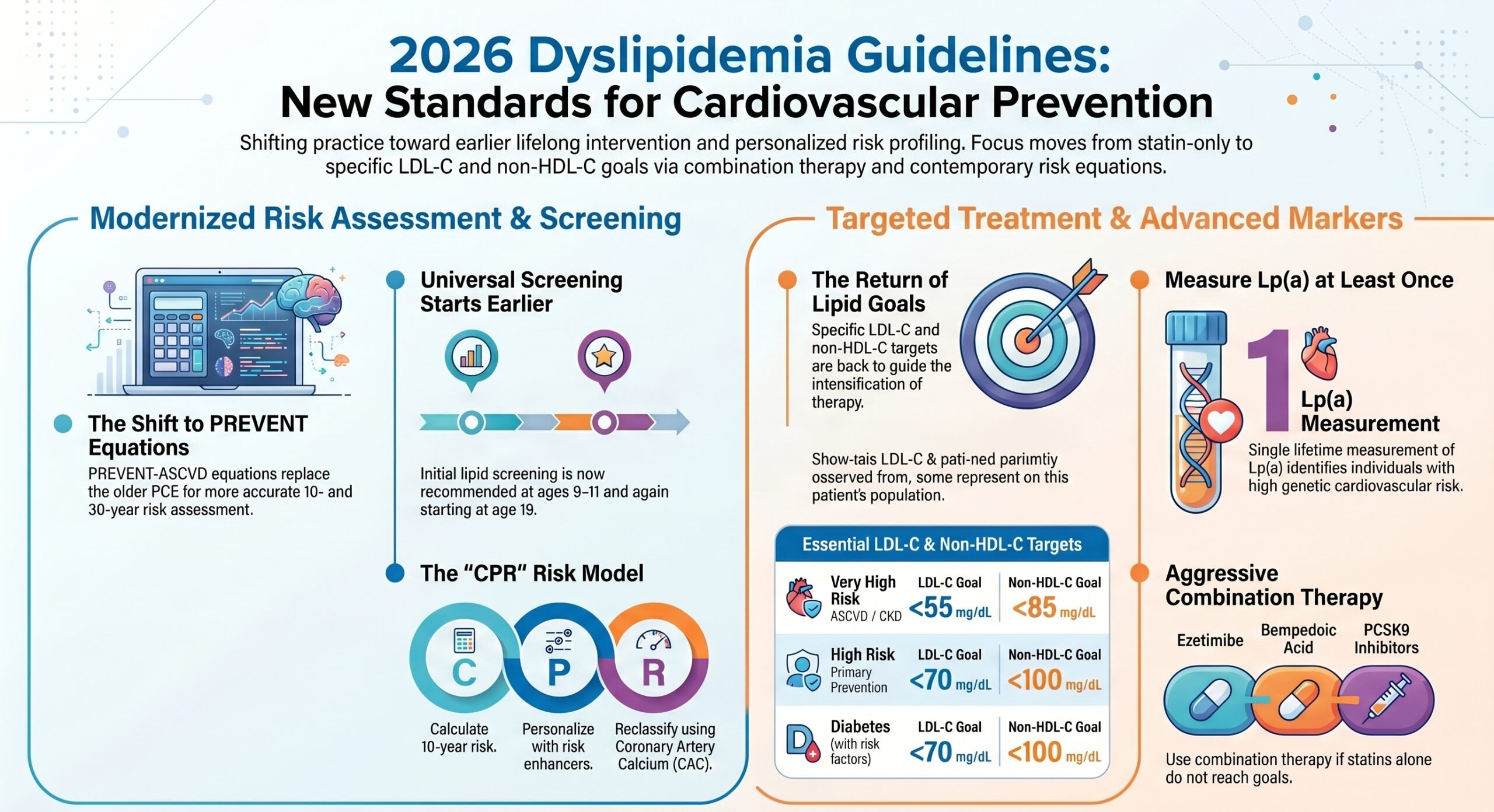
New Cholesterol Guidelines 2026: LDL Targets, Lp(a), and What Changed
Coronary Artery DiseaseHigh Cholesterol & Lp(a) The 2026 ACC/AHA Dyslipidemia Guideline introduces five major changes: a new risk calculator (PREVENT…
-

How Do I Lower My Lp(a) Cholesterol?
High Cholesterol & Lp(a) Lipoprotein(a), or Lp(a), is one of the most important and most overlooked cardiovascular risk factors. Unlike…
-

Omega-3 Fatty Acids and Heart Health: Evidence, Dosing, and the REDUCE-IT Trial Explained
Coronary Artery DiseaseHeart Attack PreventionHeart DiseaseHigh Cholesterol & Lp(a) Omega-3 fatty acids for heart health represent the most extensively studied…