Heart attacks are largely preventable.
A heart attack doesn’t have to be inevitable. With advanced testing and early intervention, we can identify hidden cardiovascular risk years before a cardiac event — and build a personalized strategy to keep your heart safe for decades to come.

Every 40 seconds, someone in the United States has a heart attack. For many of them, that heart attack is their first symptom of heart disease — no warning, no chest pain beforehand, no indication that anything was wrong.
This is what makes heart attacks so terrifying: they seem to strike out of nowhere. But here’s what most people don’t understand. Heart attacks don’t happen suddenly — they’re the culmination of years or decades of silent disease progression. The damage was building all along. It just wasn’t being detected. Waiting for symptoms is not a prevention strategy.
What actually causes a heart attack?
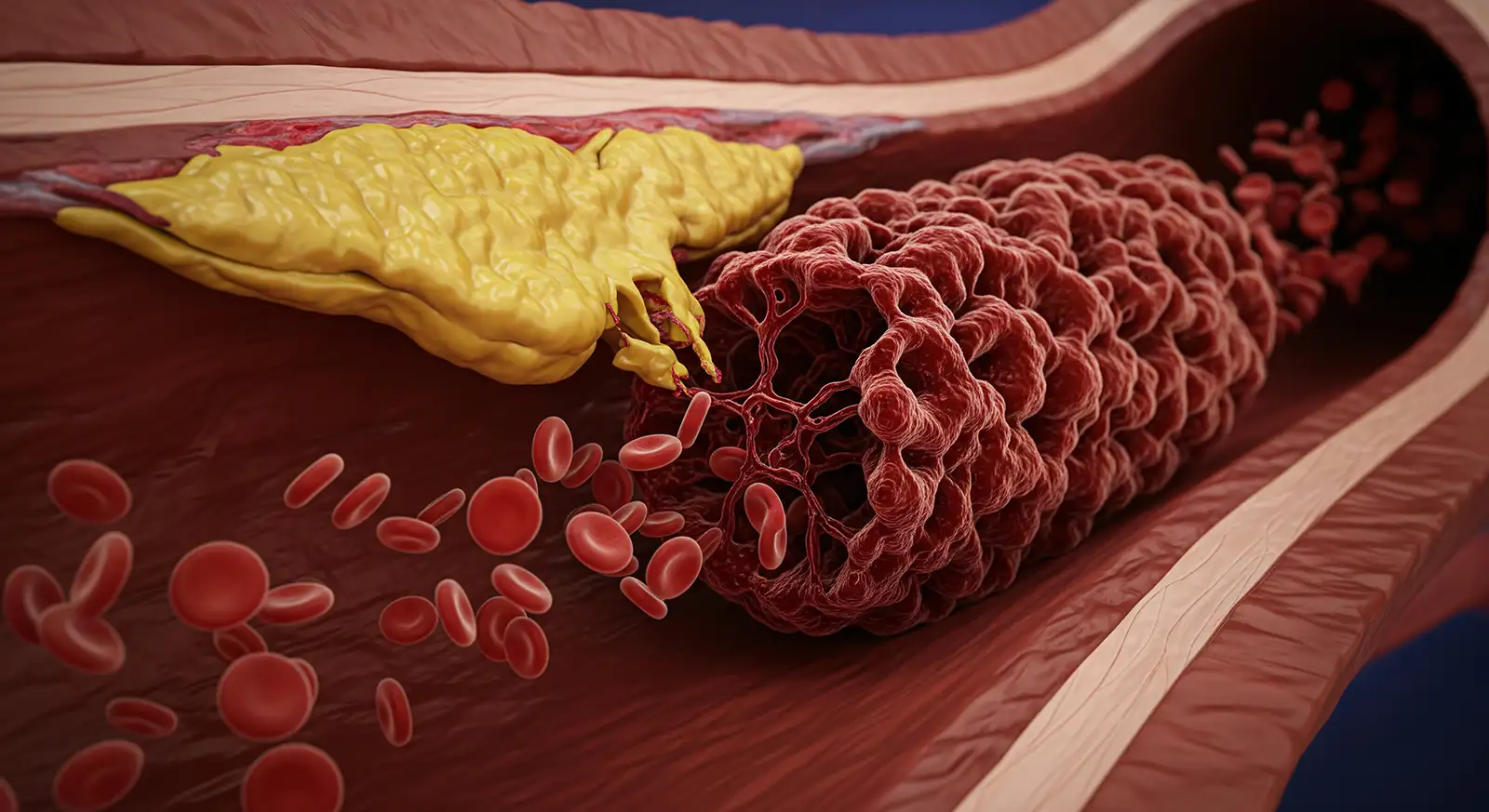
A heart attack (myocardial infarction) occurs when blood flow to part of the heart muscle is blocked, usually by a blood clot. Without oxygen, the affected heart tissue begins to die within minutes. The longer the blockage persists, the greater the damage. But what causes that clot to form in the first place? This is where the conventional understanding falls short.
Most people assume heart attacks happen when plaque gradually narrows an artery until it finally closes off. In reality, most heart attacks are caused by plaque rupture, not gradual blockage. A vulnerable plaque with a thin, inflamed cap suddenly breaks open; the body forms a clot to seal the rupture; and that clot can completely block the artery within seconds.
This is why someone can have a “mild” blockage on an angiogram one month and a massive heart attack the next. The plaques most likely to rupture are often not the ones causing the most narrowing — they’re the inflamed, unstable ones that standard testing may miss entirely.
Why standard prevention falls short
Conventional heart attack prevention typically focuses on managing traditional risk factors: lowering LDL cholesterol, controlling blood pressure, and prescribing aspirin or statins. These interventions help — but they leave significant gaps. Consider these sobering facts:
- Half of all heart attacks occur in people with normal cholesterol levels.
- Many patients have heart attacks despite taking statins faithfully.
- Standard stress tests miss up to 30% of significant coronary disease.
- Risk calculators routinely underestimate risk in certain populations, including women and younger adults.
The problem isn’t that conventional medicine is wrong — it’s that it’s incomplete. Focusing only on LDL cholesterol while ignoring genetic drivers, inflammation, insulin resistance, particle characteristics, and plaque stability leaves you partially protected at best.
What actually predicts a heart attack.
At our practice, we assess the factors most closely linked to plaque rupture and cardiac events — the drivers standard screening tends to miss.
Inflammation
Chronic inflammation destabilizes plaque and makes rupture more likely. Markers like hsCRP, Lp-PLA2, and MPO help us assess inflammatory burden in your arteries. Elevated inflammation dramatically increases heart attack risk — even when cholesterol looks acceptable.
Advanced Lipid Markers
Standard cholesterol panels tell only part of the story. We measure LDL particle number and size, because small, dense LDL particles are far more dangerous than large, buoyant ones. Two people with identical LDL cholesterol can carry vastly different risk.
Lipoprotein(a)
Lp(a) is a genetically determined risk factor affecting roughly one in five people. It significantly increases heart attack and stroke risk, yet most patients have never had it measured — and unlike standard cholesterol, it doesn’t respond to diet or statins.
Insulin Resistance
Metabolic dysfunction promotes inflammation, creates dangerous lipid patterns, and accelerates atherosclerosis. Many people have significant insulin resistance for years before their blood sugar becomes abnormal. Testing fasting insulin identifies this risk early.
Arterial Imaging
Blood tests reveal risk factors; imaging shows what’s actually happening in your arteries. A coronary artery calcium (CAC) score reveals whether plaque has formed, and CT angiography can identify the soft, vulnerable plaques most likely to rupture.
Additional Contributing Factors
Elevated homocysteine damages the arterial lining; oxidized LDL triggers inflammation; fibrinogen and clotting factors raise clot risk; sleep apnea creates repeated cardiovascular stress; and chronic cortisol elevation drives inflammation and metabolic dysfunction.
Warning signs you shouldn’t ignore
While many heart attacks occur without prior symptoms, some warning signs may appear in the days, weeks, or months beforehand:
- Chest discomfort, pressure, or tightness, especially with exertion
- Shortness of breath that’s new or worsening
- Unusual fatigue, especially in women
- Discomfort in the jaw, neck, shoulder, arm, or upper back
- Lightheadedness or dizziness
- Nausea or cold sweats without obvious cause
- A sense that something is wrong, even if you can’t explain it
The fear of the unknown
If heart disease runs in your family, or you’ve been told you have risk factors, you may carry a constant low-level anxiety about your heart. You wonder if every episode of indigestion might be something more. You think about whether you’ll be there to see your children grow up or enjoy your retirement. This fear is understandable — but living in fear without taking action only adds to your stress, which itself increases cardiovascular risk.
There’s another way. When you truly understand your cardiovascular status through comprehensive testing, fear transforms into knowledge — and knowledge gives you the power to act. Our patients consistently tell us that knowing their actual risk, even when the news isn’t perfect, feels better than wondering in the dark.
Identify risk before damage occurs.
We take a comprehensive, proactive approach to preventing cardiac events — built on advanced testing and a personalized plan that targets your specific risk factors, not just the obvious ones.
Testing that goes far beyond standard panels.
- Inflammatory markers, including markers of vascular inflammation that predict plaque instability.
- Advanced lipid analysis — particle number, size, and oxidized LDL.
- Metabolic assessment to catch insulin resistance years before blood sugar rises.
- Medical-grade genetic testing, including Lp(a).
- Arterial imaging (CAC scoring, CT angiography) when indicated.
- The goal: identify every significant risk factor, not just the obvious ones.
A strategy built around your results.
- Anti-inflammatory nutrition proven to reduce inflammation and stabilize plaque.
- Targeted supplementation — omega-3s, vitamin K2, CoQ10, and other cardioprotective nutrients.
- Metabolic optimization to reverse insulin resistance and restore healthy blood sugar.
- Blood pressure control that addresses root causes, not just the number.
- Stress & sleep — calming the nervous system and treating sleep apnea.
- Strategic medications, used precisely when your profile calls for them.
Prevention is ongoing — and your genes are not your destiny.
Prevention isn’t a one-time event. We monitor your progress with follow-up testing to ensure interventions are working, and as your body responds, we adjust the plan to optimize outcomes. Our Fit in Your GENES® Program provides the structure and support needed for lasting change.
And while genetics influence your baseline risk, lifestyle factors have an enormous impact. Studies show that even people with high genetic risk can reduce their heart attack risk by 50% or more through optimal lifestyle and medical management.
Heart attack prevention, answered.
01 I feel fine. Do I really need to worry about heart attack prevention? +
02 My cholesterol is well controlled on medication. Isn’t that enough? +
03 At what age should I start thinking about heart attack prevention? +
04 Can heart attack risk really be reduced, or is it mostly genetic? +
05 How often should I be tested? +
The best heart attack is the one that never happens.
A heart attack doesn’t have to be your first indication that something is wrong. With the right testing and a personalized prevention plan, you can identify and address risk factors years before they cause harm. Schedule a free Heart Health Strategy Session to review your history, answer your questions, and learn whether our approach is right for you.
Free, no-obligation strategy session. · Call or text 877-511-5166
Speak with a Human →
EVIDENCE
Sources & Citations
+
Incidence, Symptoms & Acute MI
- American Heart Month — February 2019. MMWR Morb Mortal Wkly Rep. 2019;68(5):101.
- Fang J, Luncheon C, Ayala C, Odom E, Loustalot F. Awareness of Heart Attack Symptoms and Response Among Adults — United States, 2008, 2014, and 2017. MMWR Morb Mortal Wkly Rep. 2019;68(5):101–106.
- Anderson JL, Morrow DA. Acute Myocardial Infarction. N Engl J Med. 2017;376(21):2053–2064.
Cholesterol, Lipids & Residual Statin Risk
- Stampfer MJ, Sacks FM, Salvini S, Willett WC, Hennekens CH. A Prospective Study of Cholesterol, Apolipoproteins, and the Risk of Myocardial Infarction. N Engl J Med. 1991;325(6):373–381.
- Durrington P. Dyslipidaemia. Lancet. 2003;362(9385):717–731.
- Yanai H, Adachi H, Hakoshima M, Katsuyama H. Molecular Biological and Clinical Understanding of the Statin Residual Cardiovascular Disease Risk and PPAR-Alpha Agonists and Ezetimibe for Its Treatment. Int J Mol Sci. 2022;23(7):3418.
- Byrne P, Demasi M, Jones M, et al. Evaluating the Association Between LDL Cholesterol Reduction and Relative and Absolute Effects of Statin Treatment: A Systematic Review and Meta-Analysis. JAMA Intern Med. 2022;182(5):474–481.
- Collins R, Reith C, Emberson J, et al. Interpretation of the Evidence for the Efficacy and Safety of Statin Therapy. Lancet. 2016;388(10059):2532–2561.
Learn More
Guides
Articles
-

What Triggers Most Heart Attacks?
Heart Attack Prevention Most heart attacks are triggered by the rupture of vulnerable arterial plaque, not by severe blockages that…
-

Magnesium and Heart Health: The Most Overlooked Mineral in Cardiology
ArrhythmiasHeart Attack PreventionHeart DiseaseHypertension Magnesium and heart health have a relationship far more consequential than standard medical practice reflects. Magnesium…
-

CoQ10 for Heart Health: Evidence, Dosing, and Why Every Statin User Needs It
Coronary Artery DiseaseHeart Attack PreventionHeart DiseaseHigh Cholesterol & Lp(a) CoQ10 for heart health is one of the most evidence-backed supplement…