Cholesterol-Lowering Supplements That Actually Work: Berberine, Bergamot, and Aged Garlic — and When to See a Cardiologist
Cholesterol-lowering supplements are one of the most common topics Dr. Regina Druz discusses with patients — both those who want to avoid statins and those already on medication who want to do more. Three supplements stand out for their clinical evidence: berberine, citrus bergamot, and aged garlic extract. Each works through a distinct mechanism, targets different aspects of the lipid panel, and carries a different risk profile.
The metrics that predict cardiovascular risk with the most precision are LDL particle number and small dense LDL (which penetrate artery walls far more readily), non-HDL cholesterol (a…
Meta-analyses report LDL reductions of ~55 mg/dL, total cholesterol reductions of ~64 mg/dL, triglyceride reductions near 75 mg/dL, and HDL increases of ~6 mg/dL.
Standard evaluation treats cholesterol as a billing code.
What cholesterol numbers are we actually trying to move?
When integrative cardiologists evaluate a lipid panel, the standard four-number summary — total cholesterol, LDL, HDL, triglycerides — is only the starting point. The metrics that predict cardiovascular risk with the most precision are LDL particle number and small dense LDL (which penetrate artery walls far more readily), non-HDL cholesterol (a more reliable surrogate for atherogenic particle burden), the triglyceride-to-HDL ratio (above 3.0 is a strong signal for insulin resistance), and lipoprotein(a) — genetically determined and largely unresponsive to lifestyle.
3 cholesterol-lowering supplements backed by clinical evidence
1. Citrus Bergamot — the most potent of the three
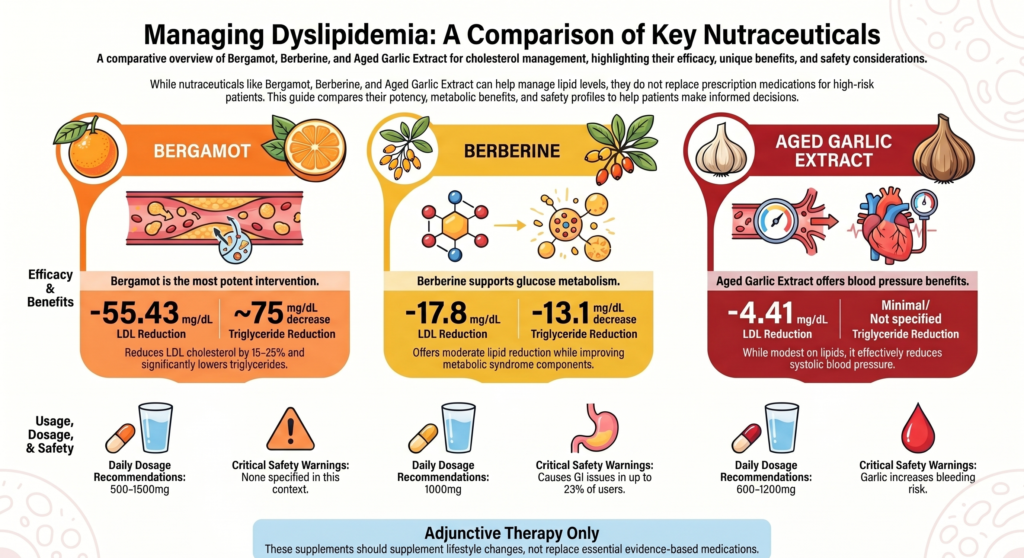
Citrus bergamot extract, derived from a fruit grown primarily in Calabria, Italy, consistently produces the most significant lipid improvements in randomized controlled trials. Meta-analyses report LDL reductions of ~55 mg/dL, total cholesterol reductions of ~64 mg/dL, triglyceride reductions near 75 mg/dL, and HDL increases of ~6 mg/dL.
Its flavonoids — neoeriocitrin, neohesperidin, and naringin — activate AMP-activated protein kinase (AMPK), the same pathway activated by metformin, and demonstrably shift LDL particle distribution toward larger, less atherogenic particles.
500–1,500 mg daily; effects are dose-dependent and typically visible on a repeat lipid panel at 3 months.
2. Berberine — the metabolic supplement
Berberine is a plant alkaloid that upregulates hepatic LDL-receptor expression by inhibiting PCSK9 — the same protein targeted by the most potent class of prescription cholesterol drugs. Meta-analyses show LDL reductions of ~18 mg/dL, total cholesterol ~18 mg/dL, triglycerides ~13 mg/dL, and HDL +2 mg/dL. It is particularly valuable in patients with concurrent metabolic dysfunction.
Berberine inhibits CYP3A4 and P-glycoprotein, which can elevate plasma levels of drugs metabolized by these enzymes — including some statins. A formal drug-interaction review is required before initiating.
500 mg twice daily with meals; start at 250 mg twice daily for 2 weeks to minimize GI adaptation effects.
3. Aged Garlic Extract — modest lipid effects, meaningful cardioprotection
Aged garlic extract (AGE) occupies a different role. Its direct lipid-lowering effect is modest — LDL reductions average ~4 mg/dL — but S-allylcysteine inhibits LDL oxidation, reduces systolic blood pressure by ~2.5 mmHg, and may slow progression of coronary artery calcium scores.
AGE inhibits platelet aggregation. Patients on warfarin, aspirin, clopidogrel, or other anticoagulants must discuss timing and dose with their physician. Discontinue 10 days before elective surgery.
600–1,200 mg daily in divided doses; 4–6 months for full lipid and antioxidant effect.
Which supplement is right for your lipid profile?
The Step 1 Explore visit includes a full review of your lipid panel, advanced biomarker testing, and a personalized supplement and lifestyle protocol from Dr. Druz.
Schedule a free call →Top Cholesterol-Lowering Supplements
These statements have not been evaluated by the Food and Drug Administration. Supplements are not intended to diagnose, cure, or treat any disease, and are not a substitute for appropriate cardiovascular evaluation with a qualified healthcare professional.
Frequently asked questions about cholesterol-lowering supplements
What is the best natural supplement to lower cholesterol?+
Citrus bergamot produces the largest reductions in published RCTs — LDL averaging ~55 mg/dL — with an excellent safety profile. That said, the best supplement depends on the mechanism driving your elevated cholesterol; patients with insulin resistance often respond better to berberine. A complete lipid evaluation is the most reliable way to match the supplement to the cause.
Does berberine actually lower cholesterol?+
Yes. Multiple meta-analyses confirm berberine reduces LDL by ~18 mg/dL, total cholesterol by ~18 mg/dL, and triglycerides by ~13 mg/dL, by inhibiting PCSK9. It interacts with CYP3A4 and P-glycoprotein, so a drug-interaction review is required before starting it alongside other medications.
Can I take berberine and bergamot together?+
There is no published evidence that combining them is unsafe, and they work through complementary mechanisms — PCSK9 inhibition and AMPK activation. In practice, identify which mechanism is most relevant to your lipid phenotype before stacking supplements.
How long does it take for cholesterol supplements to work?+
Expect 2–3 months before a meaningful change appears on a repeat lipid panel, and 4–6 months for full effect. Recheck at 3 months minimum — testing at 4–6 weeks is too early and frequently leads to premature discontinuation.
Are cholesterol-lowering supplements safe to take with statins?+
Bergamot has the most favorable profile alongside statins. Berberine requires caution because it inhibits CYP3A4. Aged garlic extract potentiates anticoagulant effects if combined with aspirin or blood thinners. All three should be discussed with your prescribing physician.
Can supplements replace statins for high cholesterol?+
Not for patients at high cardiovascular risk. Statins have decades of randomized-trial evidence for reducing heart attack, stroke, and cardiovascular death. Supplements improve lipid numbers but have not been studied for hard outcomes at scale. The decision requires risk stratification, not just a cholesterol number.
When to see a doctor about your cholesterol
Supplements are appropriate tools for specific clinical situations — not a default response to any elevated number. See a physician promptly if any of the following apply:
- !Your LDL is above 190 mg/dL — typically indicates familial hypercholesterolemia, requiring medical management
- !You have a 10-year cardiovascular risk above 7.5% — the evidence-based threshold for statin consideration
- !You have diabetes, chronic kidney disease, or established heart disease
- !You have been prescribed a statin and are stopping it without medical supervision
- !Your triglycerides are above 500 mg/dL — the risk of pancreatitis requires immediate evaluation
- !You have a family history of early heart attack or stroke (men under 55, women under 65, first-degree relative)
The integrative cardiology approach to cholesterol
Standard evaluation treats cholesterol as a billing code. As an integrative cardiologist, Dr. Druz approaches it as a symptom — one that points to an upstream cause a statin prescription does not address. The testing that informs supplement selection goes beyond the four-number panel: NMR LipoProfile, Lp(a), fasting insulin and HOMA-IR, hs-CRP and oxidized LDL, a full thyroid panel, and coronary artery calcium scoring when risk stratification is uncertain.
References
- Blais JE, et al. Berberine for the Treatment of Dyslipidemia in Adults. Drugs. 2023;83(5):455-476.
- Sadeghi-Dehsahraei H, et al. Bergamot Supplementation on Lipid Profiles. Phytotherapy Research. 2022.
- Bashiri S, et al. Aged Garlic Supplementation on Blood Pressure and Lipid Profile. Phytotherapy Research. 2025.
- Lei L, et al. Berberine and Adiposity in Obesity and MASLD. JAMA Network Open. 2026.
- Toth PP, et al. Bergamot Reduces Plasma Lipids and Small Dense LDL. Frontiers in Pharmacology. 2016.
- Rondanelli M, et al. Bergamot Phytosome Improved Visceral Fat and Lipid Profiles. Phytotherapy Research. 2021.