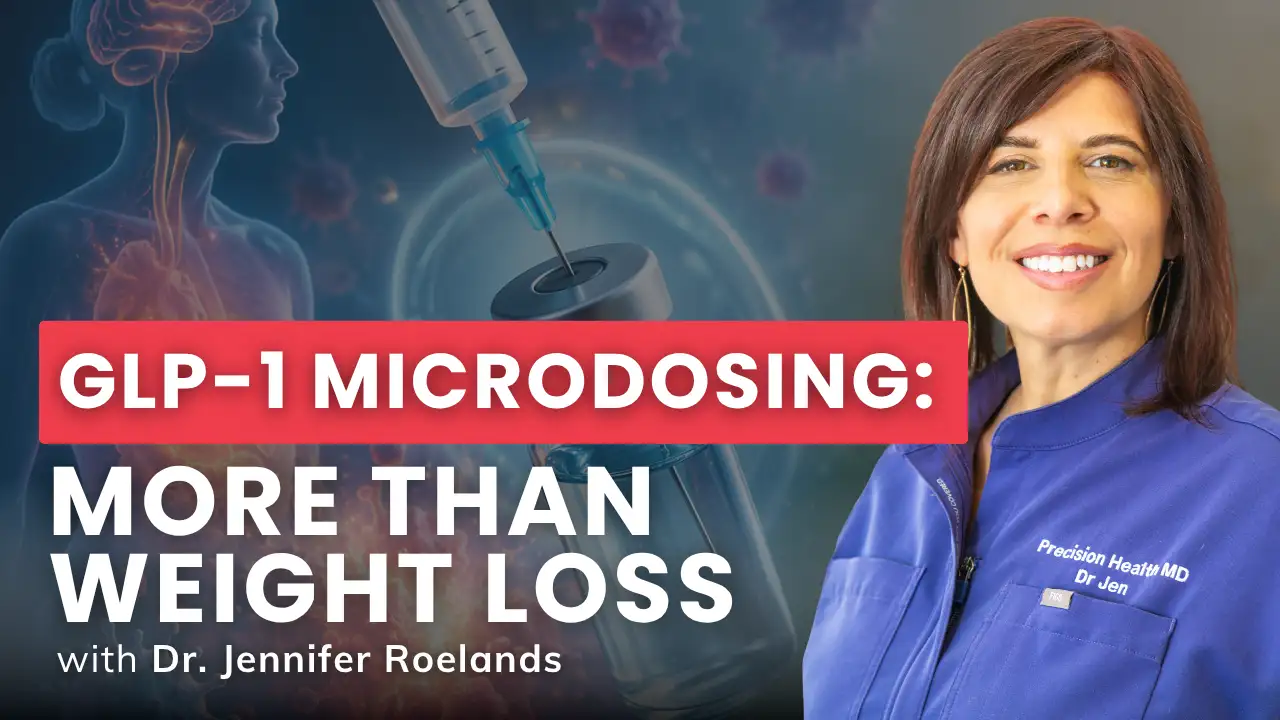
Guest: Dr. Jennifer Roelands, MD — Integrative Gynecologist & Longevity Physician
In this episode, Dr. Regina Druz is joined by Dr. Jennifer Roelands — a board-certified OB-GYN who practices integrative gynecology and longevity medicine — to reframe GLP-1 agonists (semaglutide and tirzepatide) as a form of hormonal replacement therapy rather than simple weight-loss drugs. They unpack why perimenopausal women experience sudden weight resistance despite clean nutrition and disciplined exercise, how microdosing can lower inflammation and insulin resistance without sacrificing muscle or facial volume, and why a structured medically supervised program — not a med-spa shortcut — is what turns these medications into durable cardiovascular and metabolic wins. The conversation also covers thyroid autoimmunity, adrenal hormones, PCOS, and practical on-boarding and off-boarding protocols.
🎬 Watch on YouTube: This episode is now available on the Own Your Heart Health YouTube channel. Subscribe to be notified.
Episode Chapters
| [00:02] | Welcome & Introduction — Dr. Jennifer Roelands |
| [02:08] | From Italian Immigrant Family to Integrative Gynecologist |
| [06:00] | Microplastics, Fertility & Ultra-Processed Foods |
| [07:19] | Beyond Sex Hormones — Thyroid, Adrenals & Metabolic Hormones |
| [12:46] | Reframing GLP-1 Agonists as Hormonal Replacement Therapy |
| [15:37] | What Microdosing Actually Means — Semaglutide vs. Tirzepatide |
| [22:01] | Timing, Dosing & Off-Boarding Protocols |
| [25:03] | Pleiotropic Effects: Inflammation, Neuroinflammation & Trauma |
| [35:14] | Why Medical Supervision Beats Med-Spas & Online Pharmacies |
| [40:20] | Preserving Muscle & Facial Volume During Weight Loss |
| [50:57] | Peptides, Stacking Errors & Building the Foundation First |
Podcast Transcript
[00:02] Welcome & Introduction
Dr. Regina Druz (00:02)
Welcome to Own Your Heart Health. I’m Dr. Regina Druz, your holistic cardiologist. This week we dive into common heart health concerns, uncovering root causes and unpacking scientific discoveries and controversies. The information provided does not constitute medical advice — please contact your healthcare practitioner before making any changes that may impact your health.
Today I’m joined by a wonderful guest. When we attended a conference together, I didn’t know her at all, but she came up to me and said, “Hi, I’m Dr. Jennifer, and I really like the things you’re talking about — can we connect?” What we’re discussing today is exactly why Dr. Jennifer is here. She is an integrative gynecologist and longevity physician, and this is an amazing opportunity for us as women to understand how our life cycle factors into our longevity. The exciting part is that we have options today that we didn’t have just a few years ago — options that bridge hormonal optimization and longevity optimization. In my opinion, these are game changers for women, especially women in perimenopause and menopause. Dr. Jennifer, welcome to the show.
Dr. Jennifer Roelands (01:42)
Thank you. I’m so excited to be here — and yes, you’re a gem. That’s why I approached you. Integrative cardiologists are hard to find.
Dr. Regina Druz (01:51)
I wish there were more of us. We’re actually training some physicians to become integrative cardiologists, so that’s always a good sign. Jennifer, I ask every guest the same opening question: how did you grow up to become an integrative gynecologist?
[02:08] From Italian Immigrant Family to Integrative Gynecologist
Dr. Jennifer Roelands (02:08)
I have a somewhat unique story. No one on either side of my family even graduated from high school. I was raised in a traditional Italian family where the expectation was to get married and have babies. My parents married at 16 and 17 and never finished school. I grew up as an unusual military kid who thought, “I don’t know what I’m supposed to do when I get older.” At 17 or 18, I didn’t have a boyfriend, so the marriage-and-babies path wasn’t going to work out. I tried this college thing, fumbled my way into medicine, and discovered that I loved helping people and loved science. I became an OB-GYN because it’s a cool specialty — you walk with patients through the whole lifespan, then with their daughters and mothers too.
I entered the integrative world when I was struggling with infertility. A patient came to me in the exact same situation — she couldn’t get pregnant, fertility doctors had dismissed her with “you’re young, it’ll work out.” I ran my own labs and realized I had PCOS and Hashimoto’s. My thyroid antibodies were a thousand and my TSH was totally normal. I helped that patient explore things more deeply — what should I eat, is it not just about medication? When I took an Institute of Integrative Nutrition class, it felt like a complete medical education I’d never received. Ultimately, my patient conceived spontaneously, and I ended up conceiving with Clomid. Once you see this, it’s hard to unsee it.
[06:00] Microplastics, Fertility & Ultra-Processed Foods
Dr. Regina Druz (04:40)
Yesterday I watched a Netflix documentary on plastic detox that focused on fertility. Decades of plastic contamination, microplastics — they are found in placenta, in breast milk; they affect genital development of babies and lead to low sperm count. It was absolutely fascinating. An investigator ran a small field trial with six couples, and without spoiling it, the results were striking. What struck me is that it examined the environment through both the lens of contamination and the broader lens of diet, exercise, and body composition.
Cardiology is backing into this truth one study at a time. We just had an article published in the Journal of the American College of Cardiology linking consumption of ultra-processed foods to incident cardiovascular events. The more ultra-processed food people consumed, the more heart attacks and strokes they had. What was fascinating is that the authors used an index called NOVA, which evaluates food processing rather than the ingredients themselves — so certain foods we would consider healthy ended up in the ultra-processed category. No wonder patients — and clinicians — are confused about nutritional strategy. So, Jennifer, as an integrative gynecologist, what is your framework for hormonal balance and optimization?
[07:19] Beyond Sex Hormones — Thyroid, Adrenals & Metabolic Hormones
Dr. Jennifer Roelands (07:19)
Most patients come in saying, “I think I have a hormonal imbalance.” They’re typically referring to sex hormones — estrogen, progesterone, and sometimes testosterone. Not every woman realizes testosterone is in that category, because we’ve demonized it. But in whole-body medicine, thyroid matters enormously. Metabolic hormones — fasting insulin, leptin — are just as critical for hormone balance as estrogen or progesterone. I describe it to patients as a symphony: every instrument has to play together. If the violin goes rogue, you can hear it above everything else.
In our type of medicine we are always the “why” seekers. Why does this lab look the way it does? Why do you have persistent thyroid symptoms even though your TSH is normal? Did anyone look at a full thyroid panel? Did they check antibodies? Thyroid antibodies are missed all the time — patients are told they have Hashimoto’s and have never had antibodies measured. That’s part of the diagnosis. If antibodies stay high, symptoms persist, so we ask: is it gut inflammation? Environmental toxins? Other hormones derailing the thyroid? Autoimmunity is essentially one problem wearing different costumes — which organ did the immune system decide to attack? Thyroid, pancreas, joints? It’s the same fundamental issue.
PCOS is the perfect example of hormones needing to be treated as a system. High testosterone leads to insulin resistance, which drives inflammation, which raises testosterone further. Giving a PCOS patient a birth control pill doesn’t stop her from gaining weight, or from experiencing brain fog and anxiety from inflammation, because two of the three corners of the triangle were never addressed.
Dr. Regina Druz (10:28)
This framing matters enormously, because when women come to me with new hypertension, chest pains, weight gain, or disrupted sleep and ask for “hormones,” they usually mean estrogen, progesterone, maybe vaginal replacement, occasionally testosterone. They aren’t thinking about adrenal hormones, which powerfully affect blood pressure regulation, water retention, and the autonomic nervous system of the heart. They aren’t thinking about thyroid, which is tied to autoimmune activity that translates into vascular risk. And they’re often not thinking about metabolic hormones at all.
[12:46] Reframing GLP-1 Agonists as Hormonal Replacement Therapy
Dr. Regina Druz (12:46)
I was recently at a conference where a nutritionist made a point that stuck with me. She said the new medications — Ozempic, Zepbound, Wegovy, and related agents — should not be thought of as weight-loss medications. They should be thought of as hormonal replacement therapy, because there is an age-related decline in the endogenous hormones these medications agonize. That reframing is profound. Jennifer, you’ve been using these in your practice. What are you seeing?
Dr. Jennifer Roelands (12:46)
I see predominantly perimenopausal and menopausal patients — and I’m in perimenopause myself, so I naturally attract people who say, “She knows what’s going on.” This population is now developing insulin resistance and inflammation precisely as estrogen declines. I describe insulin to patients as the bouncer of the bar — it decides whether glucose goes in to make energy, or goes to storage. Estradiol is the bar manager who tells the bouncer what to do. When the bar manager leaves, the bouncer starts making his own decisions, and that is not good.
So you have insulin resistance, inflammation, and lowering estrogen cascading into weight gain. Women tell me, “I am doing everything — I’m eating clean, I’m exercising.” They often don’t recognize that they’re losing muscle because they’re not doing resistance training. When GLP-1s exploded in use a couple of years ago, patients started telling me, “I don’t meet the insurance BMI criteria, but I want to try a low dose.” With compounding, we could prescribe off-label to patients who needed to lose 10, 15, 20, 30 pounds — not the 200-pound trial populations — and who really had metabolic dysfunction to correct. That’s how I started microdosing.
[15:37] What Microdosing Actually Means — Semaglutide vs. Tirzepatide
Dr. Regina Druz (15:37)
Let me unpack this for listeners. Compounding pharmacies are allowed to provide medications containing active ingredients from FDA-approved drugs, particularly during shortages — and we had several with semaglutide. That allowed clinicians to manipulate dosages. Currently, with the FDA no longer recognizing shortages, a well-established pathway for microdosing comes directly from the manufacturer. At Holistic Heart Centers we use LillyDirect, which provides vials of tirzepatide (brand name Zepbound; the diabetic formulation is Mounjaro). From a vial you can draw any amount, which is technically what microdosing means — any dose below the official starting dose.
This is off-label use of an FDA-approved medication, which physicians are permitted to do. Jennifer, when you refer to microdosing, which agent, what starting dose, and what patient profile leads you to choose this strategy?
Dr. Jennifer Roelands (18:35)
First, who chooses microdosing? Often it’s a patient about to start HRT — it will take a couple of months for HRT to optimize her body composition, and she wants the weight-loss process going in parallel, because it’s hard to stay motivated at the gym when nothing is moving. So question one is always: is this for weight loss, or for another indication? I have patients with binge eating disorder for whom decrease in food noise has drastically changed their lives — that’s a neuroinflammation pathway, not a weight goal, and the doses are very small.
Next I assess rate of weight loss desired and current lifestyle. If a patient tells me, “I eat terribly, I have four kids, I’m running through drive-throughs,” I’m not going to push higher and higher doses. You’d be pushing a boulder uphill. I usually start with semaglutide at 0.25 mg — the starting dose — or even half of that. The dose is weekly. I always ask if they’ve used GLP-1s before, because if they were previously on 0.75 mg three years ago, starting at half the starting dose today won’t do much for them.
On off-boarding, in my experience it goes better to wean than to stop cold turkey. The body went from an endogenous hormone with a short half-life to a weekly injection, and if you pull it abruptly, patients tell me the food noise roars back. That’s a predictable biologic response.
[22:01] Timing, Dosing & Off-Boarding Protocols
Dr. Regina Druz (22:01)
This is exactly right. In the original clinical trials, which did not use microdosing, patients were on full pharmacological doses for 12 to 18 months. People sometimes expect miraculous results in weeks, but these are part of a hormonal replacement strategy. The medications potentiate hormones that the body naturally makes and which decline with age.
What I’ve observed as someone who used microdosing myself, and who is now on the initial Zepbound dose, is a clear anti-inflammatory effect at the low doses. In cardiology, we have a parallel concept with statins — what we call pleiotropic effects: vascular-stabilizing properties that are independent of the dose-related lipid effect. There’s growing recognition that semaglutide and tirzepatide have pleiotropic effects too — in the central nervous system, in the vascular endothelium. Trials show favorable vascular effects that track with the drug, not with the weight loss. Are you seeing this anti-inflammatory effect in your patients?
[25:03] Pleiotropic Effects: Inflammation, Neuroinflammation & Trauma
Dr. Jennifer Roelands (25:03)
Exactly the same thing. Patients on low doses tell me, “I didn’t lose a lot of weight, but the puffiness is gone. My joints feel better. My brain is clearer. It’s like someone melted the inflammation away.” That tells me we’re moving in the right direction — because the goal for this population is to lower the two biggest drivers, insulin resistance and inflammation.
Let me give you an example. I had a patient who was absolutely dialed in — macros, micros, protein, fiber — and could not lose weight. When I dug into the mind-body side, she told me she had lost her 19-year-old son to cancer and had never been the same. In traditional medicine, adrenal measurement is a disaster — it’s essentially not recognized. She wanted to try a low dose of a GLP-1 because she felt inflamed. She took half the starting dose, did nothing else, and lost 10 pounds in six weeks. Nothing dramatic. But her brain fog lifted, and she told me, “My brain feels ready to process this trauma.” I sent her to a hypnotherapist, and she maintained her weight after coming off the GLP-1. She needed a biological nudge to access trauma work.
Patients report their asthma improves. Arthritis improves. Patients on immunomodulatory biologics report they don’t need them as often. We know GLP-1s lower inflammation — we simply don’t yet know how broadly. Diabetics are the classic example: they don’t just improve glycemically, they report other comorbidities improving too.
Dr. Regina Druz (28:15)
This connects to something integrative and functional medicine does well — tissue-level thinking. A functional medicine colleague of mine used to say, “In traditional medicine we look for issues with tissues; in functional medicine we look for tissues with issues.” In cardiology, we’re finding that GLP-1 agonists reduce cardiac events — and increasingly the evidence suggests this is independent of weight loss, through cardiometabolic remodeling. In heart failure with preserved ejection fraction, these medications appear to reduce the volume of epicardial adipose tissue — the fat that sits on top of and infiltrates the heart — and shut off its inflammatory signaling.
Are you aware of any formal studies on microdosing? I searched the literature and found only sporadic observational reports.
Dr. Jennifer Roelands (31:09)
Right — mostly observational, nothing that meets the randomized controlled trial gold standard. I have no doubt Eli Lilly will eventually run formal microdosing or low-dose trials, especially now that they have direct-to-consumer offerings. The original FDA approvals were for obesity and diabetes — not perimenopause, not chronic inflammatory conditions, not binge eating. Formal evidence for those uses is not yet there, though it would be enormously valuable.
Dr. Regina Druz (33:09)
It would be valuable. And since we’re both integrative physicians, it’s important to emphasize that these medications truly shine as part of a structured program. When we work with patients on insulin sensitivity, personalized nutrition, sleep, stress, and movement — and treat the medication as an enhancement rather than the entire strategy — three things happen. One: we get a deeper result than medication alone. Two: we can often use a lower dose, with fewer side effects. Three: when the medication is eventually tapered, the foundational skills allow patients to maintain their gains.
[35:14] Why Medical Supervision Beats Med-Spas & Online Pharmacies
Dr. Jennifer Roelands (35:14)
Yes — and my answer to the patient who says, “Doc, just give me the drug, I’ll sort the rest out,” is, “Then you can probably get it online.” I don’t allow patients in my practice to just do anything, the same way I wouldn’t let them self-manage hypertension or diabetes medications. The downside to the current landscape is that there are a million online companies, med-spas — gyms these days have a salesperson on the corner. You can access it, but you won’t get sustainable weight loss or sustainable health optimization.
When I used GLP-1s myself in early perimenopause — eight pounds appeared out of nowhere — I was the person who ate asparagus for breakfast. But I discovered behaviors I hadn’t noticed: if I had a second glass of wine I was more likely to have dessert. When I actually counted my fiber, I was at 15 grams — embarrassing. I thought I was doing fiber and protein correctly, and I really wasn’t. That’s information you only get through a clinical relationship.
Patients come to me saying, “I did a med-spa program, nobody follows up, I got off and had to get right back on.” I ask, did they measure your hormones? Your fasting insulin? Your CRP? Your metabolic markers? If none of those got better on the GLP-1, we were probably on the wrong dose or even the wrong drug — semaglutide is different from tirzepatide, which is different from retatrutide. You have to see the biomarkers move to know you’re on the right medication, the same way you check blood pressure to know if a blood pressure pill is working.
[40:20] Preserving Muscle & Facial Volume During Weight Loss
Dr. Regina Druz (40:20)
Another critical issue: these medications, at full pharmacological doses in clinical trials, did not spare skeletal muscle. Up to 40% of the weight lost came from lean mass, which is not where anyone wants to be. With microdosing and medical supervision we can prioritize fat loss over muscle loss — in our patients, typically only about 4% of weight lost is muscle. Part of that is timing: microdosing avoids exposure to full pharmacological doses from day one, so the body can adjust. Patients can structure their nutrition better because food noise is quieter and they can make deliberate choices — more fiber, better protein, better decisions. Jennifer, what’s your favorite microdosing protocol?
Dr. Jennifer Roelands (40:20)
One more thing on muscle — and specifically face loss. I do aesthetics, so this is real. Patients say “I want to lose 10 pounds this month,” and I say, “No, you don’t.” At 25 you’d get it back; at 55 you won’t. If you lose weight too fast, it comes out of your face too, and the only option then is to fill it back in. Preserve the real estate.
I typically start with semaglutide. If someone doesn’t tolerate GLP-1s on a small dose — severe nausea, constipation, exhaustion — giving them tirzepatide is not going to fix that. Tirzepatide in my experience has less nausea, but if someone flat-out feels awful on semaglutide, escalating to two hormones isn’t the answer. Tirzepatide is also generally more expensive. Starting with semaglutide is a safer test of the waters.
If the patient has food-related behavioral patterns — raised in a culture where food equals love, or where they had to clean the plate, or craving fast food at the smell of it — I find tirzepatide works a little better, likely because of the GIP hormone component.
My typical rhythm: the patient gives themselves the first shot in the clinic so I know they can do it. I send them home with one dose. We reassess at two weeks. How much weight moved? How did you feel? How much of the nutrition guidance did you implement? Then we set up a four-shot rhythm, one monthly visit, with access to me by email or phone. I always prescribe Zofran for backup nausea — sometimes a patient gets the flu three days after a shot, or a college student finishes exams eating caffeine and donuts and needs rescue. I have a very direct conversation about fiber and constipation — don’t wait three to five days, it does not get better on its own.
At the four-week mark we discuss: dose up, hold, or even scale down. If someone lost six pounds in the first month I might slow them down to preserve real estate. By month two we talk about off-boarding — spacing out doses, decreasing the dose, or moving to maintenance. A few of my patients do maintenance, one shot every three to four weeks, purely to keep inflammation at bay. That’s deeply off-label and not formally studied, but it works clinically.
Dr. Regina Druz (46:26)
Even conventional obesity experts now say we go as fast or as slow as the patient can tolerate. I tell my patients: this is not a race. There are no brownie points for escalating your dose every month. You may stay on the same dose for two months. This is a form of hormonal replacement, and since we can’t reliably measure these endogenous hormones in a living patient, each individual becomes their own calibration. The slower we go, the better patients seem to respond — because they get the time to dial in the foundation.
If a patient lands on a maintenance dose, do they typically come off it entirely, or is some residual dosing helpful?
Dr. Jennifer Roelands (48:19)
The majority of patients off-board completely. They figured out the why — they’re now on HRT, they’re lifting weights, sleeping, getting fiber, getting protein, moderating alcohol — and the medication is no longer needed. The small number who stay on maintenance, I re-engage every six months with full biomarker labs. If nothing has changed, I mail them a six-month vial supply from the pharmacy; by that point they know how to draw up the medication.
For patients where the drug stops working, we troubleshoot: maybe tirzepatide is the better option, maybe thyroid is suboptimal, maybe hemoglobin A1c is too high and the GLP-1 is trying to be the whole cake instead of the icing. GLP-1s are the icing. The foundation has to be there or the medication can’t do its job. Once the foundation is dialed in, patients often come down to very low doses — someone on 0.25 mg with six-pound monthly loss and beautiful labs may drop further, not higher. That kind of personalization is what you cannot get from mass-volume med-spa prescribing.
[50:57] Peptides, Stacking Errors & Building the Foundation First
Dr. Regina Druz (50:57)
This point cannot be overstated. All hormonal replacement therapy — and GLP-1 agonists (semaglutide, tirzepatide, the dual-incretin agents, and retatrutide as a triple agonist) are hormones — shines when the foundation is dialed in. Bringing HRT onto unprepared terrain is when side effects appear and strategies backfire. The same principle applies to peptides. These medications are FDA-approved peptides in their chemical structure. What we’re seeing in culture right now I call “shiny object syndrome” — people want a shortcut, a magical injectable — without putting in the foundational work. Unfortunately, some patients learn in their own skin that time favors those who take the time to prepare. Jennifer, last words for our listeners.
Dr. Jennifer Roelands (52:53)
I want to emphasize something our colleague Dr. Shaw discussed in a recent interview: some peptides interact with other peptides, and stacking them incorrectly cancels their benefit. You can’t throw BPC-157 into a shot with another peptide and assume both will work — you may have just neutralized one of them. Cycling matters. Timing matters. Without supervision, patients are wasting money and undermining results. It has to be a personal approach, and it has to be medically supervised.
Dr. Regina Druz (54:00)
Building the foundation is not glamorous, it is not sexy, it is work, it doesn’t make headlines — but it gets you far. I always use the house analogy: you need a roof, but there is no roof without a foundation. Jennifer, thank you so much — enormously informative. To our listeners, if you have questions, please post them; we do our best to respond. We can’t provide medical advice, but we can guide your thought process.
Dr. Jennifer Roelands (54:56)
Thank you so much.
Dr. Regina Druz (54:58)
Thank you for tuning in to Own Your Heart Health with Dr. Regina Druz. This podcast is powered by Holistic Heart Centers. If you enjoyed the show, please rate and review us on your favorite podcast platform. To learn more about our services, visit holisticheartcenters.com and subscribe to our YouTube channel — the link is in the show notes. See you next week.
Frequently Asked Questions
Microdosing refers to prescribing these medications at doses below the official FDA starting dose. For semaglutide, the approved starting dose is 0.25 mg weekly; a microdose might be 0.125 mg or lower. This is an off-label use of an FDA-approved medication, which physicians are permitted to prescribe when clinically appropriate. The goal is not maximum weight loss — it is a targeted reduction in inflammation and insulin resistance, particularly in perimenopausal and menopausal women who are resistant to weight loss despite good nutrition and exercise. At low doses, patients often experience reduced joint pain, clearer cognition, better sleep, and modest weight loss without the nausea or muscle wasting associated with higher doses. Microdosing is not appropriate for every patient and is not a substitute for foundational work — sleep, strength training, whole-food nutrition, and stress management. It should only be undertaken under medical supervision with baseline and follow-up biomarker testing.
GLP-1 and GIP are hormones the body produces naturally, and their levels decline with age — part of the broader hormonal shift that accelerates during perimenopause and menopause. GLP-1 agonists such as semaglutide and tirzepatide potentiate these hormone pathways, which is why they affect appetite, insulin signaling, inflammation, and cardiovascular risk — not just weight. Clinical trials have shown that the cardiovascular benefits of these medications track with the drug itself, independent of weight loss, suggesting direct vascular and anti-inflammatory effects. Emerging evidence also suggests these drugs reduce epicardial adipose tissue — the inflammatory fat surrounding the heart — which is implicated in heart failure with preserved ejection fraction (HFpEF). Understanding these medications as hormonal replacement reframes expectations: results build over months, not days, and work best alongside a personalized protocol that addresses thyroid, adrenal, and sex hormones in parallel.
Good candidates are typically perimenopausal or menopausal women experiencing new weight resistance, elevated fasting insulin, hs-CRP, or other markers of metabolic dysfunction — especially those already optimizing nutrition, movement, and sleep. Patients with PCOS, binge eating disorder, or persistent systemic inflammation despite clean lifestyle foundations may also benefit. Microdosing is generally not appropriate for patients at a healthy weight with normal metabolic markers who simply want to slim down, patients with active gastrointestinal disease, those with a history of medullary thyroid cancer or MEN-2, pregnant or breastfeeding patients, or patients unwilling to engage in foundational lifestyle work. Because muscle loss is a known risk at higher doses, candidates should be committed to resistance training during treatment. Facial volume loss is another consideration, particularly for women over 40 — faster weight loss means faster facial fat loss. A thorough clinical assessment, including thyroid panel, fasting insulin, CRP, and hormone levels, is essential before starting.
Without supervision, patients lose the clinical feedback loop that makes these medications effective. You cannot tell whether a GLP-1 is working — or whether it is the right one — without measuring the biomarkers it is supposed to move: fasting insulin, hs-CRP, hemoglobin A1c, hormone levels, and others. Semaglutide, tirzepatide, and the newer retatrutide behave differently; the right choice depends on the patient. Unsupervised use also misses the common co-factors that prevent GLP-1s from working — suboptimal thyroid, unaddressed autoimmune inflammation, inadequate protein or fiber intake, excess alcohol, or poor sleep. Patients frequently come back from unsupervised programs saying the medication stopped working or they regained weight immediately after stopping. Dr. Roelands emphasizes a structured on-boarding and off-boarding protocol, with dose adjustments based on biomarker trends and the patient’s own experience — something no mass-market program provides.
Dr. Roelands recommends weaning rather than stopping abruptly. The body has adjusted to a weekly exogenous hormone signal, and cold-turkey discontinuation often triggers a return of food noise, inflammation, and cravings. Options include spacing doses further apart (every 10 to 14 days), reducing the weekly dose gradually, or transitioning to a maintenance schedule (one shot every three to four weeks) for patients whose inflammation returns without it. The majority of patients off-board completely once their foundation is solid — they have figured out what nutrition, sleep, resistance training, and hormone optimization they individually needed, and the medication becomes unnecessary. A small number remain on maintenance dosing, and in those cases clinicians should continue ordering biomarker panels every six months. Throughout off-boarding, patients should continue prioritizing protein, fiber, hydration, and strength work — the foundation is what sustains the result, not the drug.
Show Notes & Resources
Guest: Dr. Jennifer Roelands, MD
Integrative Gynecologist | Longevity Physician | Board-Certified OB-GYN
Focus: Perimenopause, Menopause, PCOS, Hormonal Optimization, GLP-1 Microdosing
Training: Institute of Integrative Nutrition | Conventional OB-GYN Residency
Resources Mentioned
- LillyDirect — direct-to-consumer access to tirzepatide (Zepbound) vials used at Holistic Heart Centers for microdosing protocols
- Dr. Tina Moore — early clinical voice on GLP-1 microdosing (referenced in episode)
- Dr. Shaw — integrative colleague referenced regarding peptide stacking and safety
- Journal of the American College of Cardiology — 2026 publication linking ultra-processed food consumption (via NOVA index) to incident cardiovascular events
- Plastic Detox documentary (Netflix) — referenced regarding microplastics and fertility
Key Terms Referenced in This Episode
- GLP-1 (glucagon-like peptide-1): An endogenous hormone released after eating that promotes insulin release, slows gastric emptying, and reduces appetite. GLP-1 levels decline with age.
- GIP (glucose-dependent insulinotropic polypeptide): A second gut hormone targeted by dual-incretin medications such as tirzepatide, contributing to appetite regulation and insulin response.
- Semaglutide: A GLP-1 agonist (brand names include Ozempic, Wegovy, Rybelsus); diabetic and weight-loss formulations differ.
- Tirzepatide: A dual GLP-1/GIP agonist (brand name Zepbound for weight management, Mounjaro for diabetes).
- Retatrutide: An investigational triple agonist (GLP-1, GIP, and glucagon) under clinical development.
- Microdosing: Off-label prescribing of GLP-1 agonists at doses below the approved starting dose, typically used for inflammation, metabolic tuning, and modest weight loss.
- Pleiotropic Effect: A biological effect of a medication independent of its primary mechanism — e.g., statins’ vascular-stabilizing benefit beyond lipid lowering, and emerging evidence for GLP-1 anti-inflammatory effects.
- Epicardial Adipose Tissue (EAT): Fat surrounding the heart that, when inflamed and infiltrative, contributes to heart failure with preserved ejection fraction.
- HFpEF: Heart failure with preserved ejection fraction — heart failure in which the heart muscle contracts normally but the ventricles are stiff.
- PCOS: Polycystic Ovary Syndrome — a metabolic-endocrine condition linked to insulin resistance, elevated androgens, and inflammation.
- Hashimoto’s Thyroiditis: An autoimmune condition in which antibodies attack the thyroid; TSH can appear normal while antibodies are very elevated.
- hs-CRP: High-sensitivity C-reactive protein — a systemic inflammation marker.
- NOVA Index: A food classification system grouping foods by degree of processing rather than nutrient content, increasingly referenced in cardiovascular and metabolic research.
- Clomid (Clomiphene Citrate): An oral fertility medication that induces ovulation.
- Zofran (Ondansetron): An anti-nausea medication commonly prescribed as rescue therapy during GLP-1 initiation.
Holistic Heart Centers
holisticheartcenters.com
HeartWell.ai — AI-powered cardiovascular risk assessment
Address: 55 Bryant Avenue, Suite #6, Roslyn, NY 11576
Phone: 877-511-5166
YouTube: @reginadruzmd | Instagram: @dr.reginadruz
Podcast: Own Your Heart Health — available on all major platforms
Listen & Subscribe
If you enjoyed this episode, please rate and review us on your favorite platform — it helps more people find the show.
Apple Podcasts | Spotify | YouTube
Medical Disclaimer
The information in this transcript is for educational purposes only and does not constitute medical advice. The discussions about stem cells, exosomes, peptides, and regenerative therapies reflect the clinical experiences and opinions of the physicians involved. These treatments are not FDA-approved for all applications discussed. Individual results vary. Please consult your licensed healthcare practitioner before making any changes to your health regimen.