

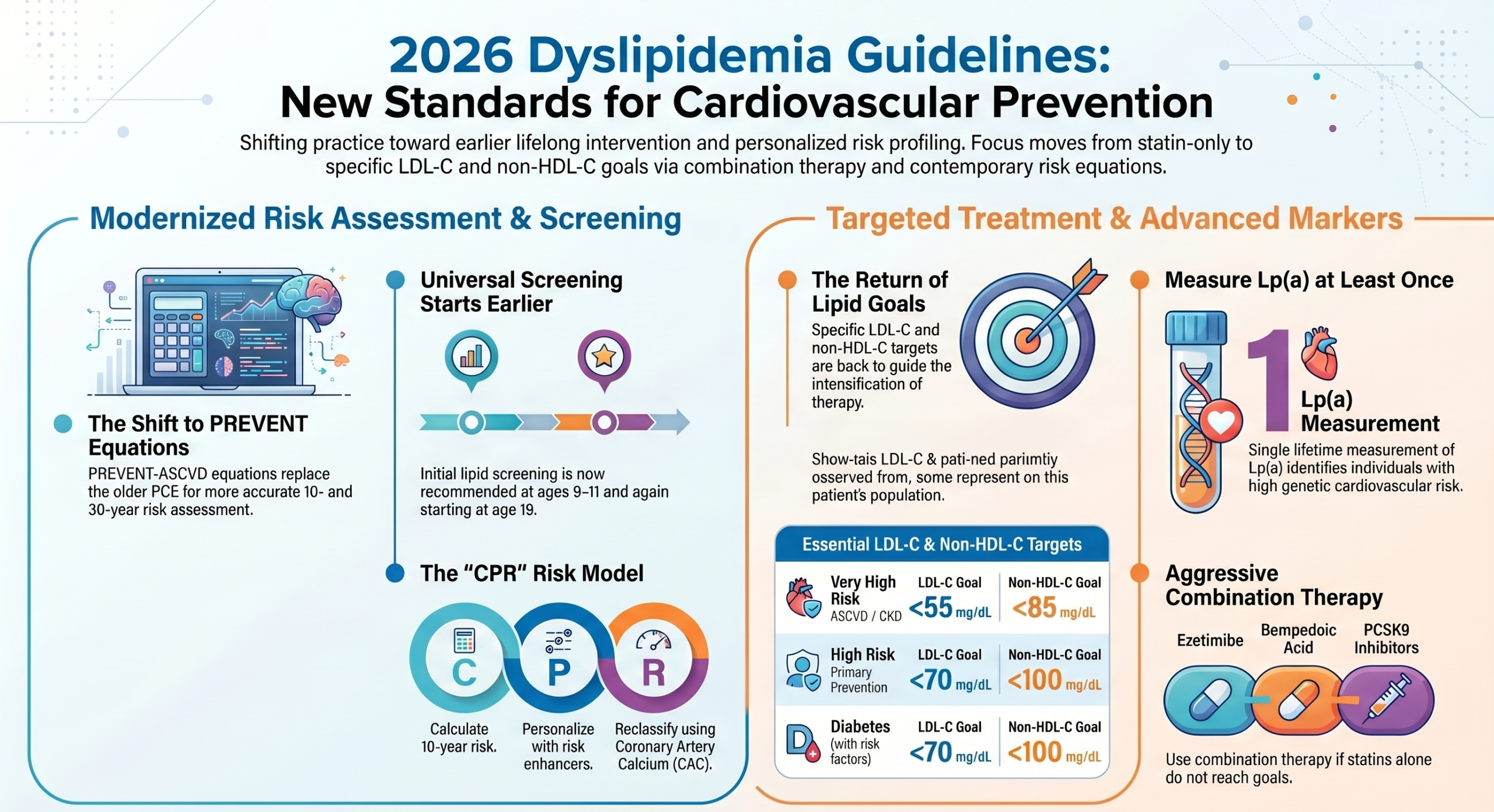
The 2026 ACC/AHA Dyslipidemia Guideline introduces five major changes: a new risk calculator (PREVENT replaces Pooled Cohort Equations), explicit LDL targets reinstated (below 55 mg/dL for highest-risk patients), universal Lp(a) testing for every adult, formal Class 3 (No Benefit) ratings for dietary supplements, and CAC score tiers tied directly to LDL goals. This article explains each change and what it means for patients managing their cholesterol in 2026.
The new cholesterol guidelines for 2026 represent the most significant update to cardiovascular risk management in nearly a decade. Released in spring 2026, the ACC/AHA Guideline on the Management of Dyslipidemia reinstates explicit LDL cholesterol targets, elevates Lp(a) screening to a universal recommendation, and formally addresses where natural supplements like berberine and bergamot fit — and don’t fit — in a modern treatment plan. As an integrative cardiologist, Dr. Regina Druz has spent months analyzing these changes and what they mean for the patients she sees who want to understand their full cardiovascular risk, not just their standard lipid panel number.
What Changed in the 2026 Cholesterol Guidelines?
The 2026 guideline replaces the 2018 ACC/AHA Cholesterol Guideline and expands its scope considerably. Where the 2018 document focused primarily on statin use and LDL percentage reductions, the 2026 update introduces explicit treatment targets, a new risk calculator, universal Lp(a) screening, and formal guidance on special populations including patients with CKD, HIV, cancer, and diabetes. The table below summarizes the most practice-changing differences.
| Domain | 2018 Guideline | 2026 Guideline | What This Means for You |
|---|---|---|---|
| Primary Risk Tool | Pooled Cohort Equations (PCE) | PREVENT-ASCVD Equations (10- and 30-year risk) | Your doctor may now calculate a different risk score than before, one that accounts for kidney function and metabolic health, giving a more accurate picture of your personal heart risk. |
| LDL Cholesterol Goals | Focus on % reduction, not a specific number | Specific LDL targets reinstated: <55 mg/dL for highest-risk patients; <70 mg/dL for others with heart disease | For the first time in nearly a decade, your doctor has a specific LDL number to aim for, not just a percentage. If you have heart disease, the new target is LDL below 55 mg/dL. |
| ApoB Testing | Not formally recommended | Class 2a: recommended for patients with heart disease, diabetes, or elevated triglycerides on treatment | If your LDL looks controlled but you have diabetes, heart disease, or high triglycerides, ask about an ApoB test, it counts atherogenic particles your LDL number may be missing. |
| Lp(a) Testing | Not formally recommended | Class 1: measure Lp(a) at least once in every adult | Every adult should now have their Lp(a) tested at least once. This genetic risk factor is not lowered by statins; if it’s elevated, your doctor needs to know and factor it into your plan. |
| Dietary Supplements | Not addressed | Class 3 (No Benefit): supplements not recommended for lowering LDL or triglycerides | The guideline found no proven benefit for supplements like fish oil, garlic, or plant sterols for lowering cholesterol. This doesn’t mean they’re harmful, it means the outcomes evidence isn’t there yet. |
| Coronary Artery Calcium (CAC) | Useful for risk reclassification | Explicit LDL goals now tied to CAC score: <100, <70, or <55 mg/dL depending on CAC level | Your CAC scan score now directly determines your LDL target. A higher calcium score means a lower LDL goal, making this scan one of the most useful tests for personalizing your treatment. |
| New Medications | PCSK9 inhibitors, ezetimibe | Adds bempedoic acid, inclisiran, and olezarsen (for very high triglycerides) | There are now more medication options available beyond statins. If you’ve struggled with statin side effects or haven’t reached your LDL goal, newer agents may be an option worth discussing. |
Table 1. Key differences between the 2018 and 2026 ACC/AHA Dyslipidemia Guidelines.
The Return of Explicit LDL Cholesterol Goals
One of the most clinically important changes is the reinstatement of specific LDL-C treatment targets. For patients at very high risk of ASCVD events — those with established heart disease and multiple high-risk features — the 2026 guideline recommends an LDL goal below 55 mg/dL and a non-HDL-C goal below 85 mg/dL. For secondary prevention patients not at very high risk, the goal is LDL below 70 mg/dL. This shift directly responds to mounting trial evidence that lower LDL is consistently associated with better outcomes.
A More Accurate Risk Calculator: The PREVENT-ASCVD Equations
The 2026 guideline replaces the Pooled Cohort Equations with the AHA PREVENT-ASCVD equations for 10- and 30-year risk estimation in adults aged 30 to 79. The PREVENT equations incorporate kidney function (eGFR) and metabolic factors, producing a more accurate and contemporary individual risk estimate. The guideline introduces a “CPR” framework for applying this tool: Calculate 10-year ASCVD risk, Personalize it with risk-enhancing factors not captured in the equations, and Reclassify with selective use of coronary artery calcium (CAC) scoring. This structured approach is precisely what Dr. Druz applies at Holistic Heart Centers — not just running the calculator, but building the full picture around the number it produces.
♥ See Your Personal Risk Numbers with HeartWell.AI
The PREVENT-ASCVD equations are only as powerful as the data behind them. HeartWell.AI is an evidence-based cardiovascular risk platform that runs your personal numbers through multiple validated risk calculators — PREVENT, PCE, MESA, SCORE2, and Reynolds — simultaneously. It factors in genetic modifiers like Lp(a) and simulates the projected impact of specific interventions on your individual risk, including medications, lifestyle changes, and supplements. The result: a patient-specific risk profile that shows not just where you stand today, but how much each treatment option is expected to reduce your risk over time.
Dr. Druz uses HeartWell.AI as part of the Step 1 Explore evaluation at Holistic Heart Centers. You can request your personalized HeartWell.AI simulation when you schedule your free patient coordinator call →
How Low Should LDL Go? What the Ez-PAVE Trial Tells Us
The 2026 guideline arrived alongside a landmark study — the Ez-PAVE trial, published in the New England Journal of Medicine — that provides the most direct randomized evidence to date for the <55 mg/dL LDL target. The trial enrolled 3,048 patients with established cardiovascular disease across 17 sites and randomized them to either an intensive LDL target of <55 mg/dL or a conventional target of <70 mg/dL. The difference in achieved LDL between the two groups was only 10 mg/dL (56 vs. 66 mg/dL) — yet the results were striking.
| Outcome | Intensive (<55 mg/dL) | Conventional (<70 mg/dL) | Hazard Ratio (95% CI) |
|---|---|---|---|
| Primary Composite Endpoint | 6.6% | 9.7% | 0.67 (0.52–0.86), P=0.002 |
| Nonfatal MI | 0.8% | 1.7% | 0.46 (0.23–0.91) |
| Any Revascularization | 4.8% | 7.5% | 0.63 (0.47–0.84) |
| CV Death | 1.0% | 1.2% | 0.83 (0.42–1.65) |
| Nonfatal Stroke | 0.5% | 0.7% | 0.80 (0.32–2.03) |
Table 2. Ez-PAVE trial outcomes at 3-year median follow-up. Intensive target: LDL <55 mg/dL. Conventional target: LDL <70 mg/dL.
The 33% relative risk reduction from just a 10 mg/dL difference in achieved LDL is clinically compelling. The Number Needed to Treat (NNT) was 32 over 3 years — meaning for every 32 patients treated to the more intensive target rather than the conventional one, one additional cardiovascular event is prevented. That is a favorable NNT, comparable to many landmark statin trials.
Two important caveats deserve mention. First, the trial enrolled exclusively East Asian patients, primarily men, which limits direct generalizability to other populations. Second, the relative risk reduction is larger than cholesterol treatment trialists’ meta-analyses would predict from a 10 mg/dL LDL difference — the reasons are not yet fully understood. Since the trial was not blinded (investigators knew which patients had lower LDL), the difference could have been driven by selective referral to procedures (look at the Any Revascularization in the table). Despite these limitations, Ez-PAVE provides the direct randomized evidence that the guideline’s <55 mg/dL target has long needed.
Why Your LDL Number Alone Is No Longer Enough: ApoB and Lp(a)
One of the most significant shifts in the 2026 guidelines is the formal recognition that LDL cholesterol is an imperfect proxy for atherogenic risk. Two additional measurements are now part of the standard of care for many patients: ApoB and Lp(a).
ApoB: The Particle Count That LDL Misses
ApolipoproteinB (ApoB) is present on every atherogenic lipoprotein particle — LDL, VLDL, and Lp(a). Because each particle carries exactly one ApoB molecule, measuring ApoB gives a direct count of atherogenic particles in circulation. A landmark UK Biobank analysis of 207,368 participants found that a one standard deviation increase in total ApoB particle count was associated with a 33% higher risk of coronary artery disease — a stronger predictor than LDL concentration alone.
The 2026 guideline now gives ApoB a Class 2a recommendation: in adults on lipid-lowering therapy with ASCVD, CKM syndrome, type 2 diabetes, or elevated triglycerides, measuring ApoB is reasonable to guide decisions about further treatment intensification. The clinical implication is significant: patients whose LDL appears well-controlled may have a hidden residual risk from elevated ApoB particle burden that only a particle count will reveal.
Lp(a): The Genetic Risk Factor Statins Cannot Touch
Lipoprotein(a) is now a Class 1 recommendation in the 2026 guidelines — meaning every adult should have it measured at least once. Lp(a) is genetically determined, meaning it does not respond meaningfully to diet, exercise, or most lipid-lowering medications. An Lp(a) level at or above 125 nmol/L (approximately 50 mg/dL) is associated with approximately 1.4-fold increased ASCVD risk. Values at or above 250 nmol/L carry a risk equivalent to heterozygous familial hypercholesterolemia.
The critical clinical point: statins do not lower Lp(a) — and may modestly raise it. This means a patient can have a “normal” LDL on a statin while carrying a significant, unmeasured genetic risk. Dr. Druz has included Lp(a) testing as part of the Holistic Heart Centers evaluation for years; the 2026 guideline now makes this the standard of care for all adults.
Beyond LDL: Understanding Residual Cardiovascular Risk
Even with LDL driven to 30 or 40 mg/dL with aggressive pharmacotherapy, the 3-year composite event rate in landmark trials remained near 10%. This persistent risk — called residual cardiovascular risk — operates through pathways that LDL lowering does not address. Identifying and targeting these pathways is central to the integrative cardiology approach at HHC.
- Residual Lipid Risk: Elevated ApoB, Lp(a), and triglycerides that persist despite optimal LDL-C. Addressed with PCSK9 inhibitors, icosapent ethyl (for elevated triglycerides), and emerging RNA therapies targeting Lp(a).
- Residual Inflammatory Risk: Elevated hsCRP at or above 2 mg/L despite optimal LDL lowering. The CANTOS trial proved the inflammatory hypothesis; the COLCOT trial demonstrated that low-dose colchicine significantly reduces events in post-MI patients.
- Residual Pro-Thrombotic Risk: Elevated platelet reactivity and fibrinogen, addressed through prolonged dual antiplatelet therapy in select patients or addition of low-dose rivaroxaban (COMPASS trial).
- Residual Metabolic Risk: Insulin resistance and obesity-driven lipid dysregulation. Increasingly addressed with GLP-1 and dual GLP-1/GIP receptor agonists, which have demonstrated cardiovascular benefits independent of weight loss.
Systematic management of residual risk requires identifying which pathways are active in a given patient — not applying the same protocol to everyone. This is precisely where advanced biomarker testing adds clinical value that a standard lipid panel cannot provide.
What the 2026 Guidelines Say About Cholesterol Supplements — and What They Don’t
The 2026 guideline issues a Class 3 (No Benefit) recommendation against dietary supplements for lowering LDL-C or triglycerides. This will surprise many patients — and it deserves honest, nuanced explanation rather than a simple “supplements don’t work” message.
Berberine: Meaningful Lipid Effects, No Outcomes Data
Berberine upregulates hepatic LDL receptor expression through a mechanism distinct from statins (stabilization of LDL receptor mRNA) and activates AMPK, improving insulin sensitivity alongside lipid metabolism. Meta-analyses of clinical trials show LDL-C reductions of approximately 15–25%, total cholesterol reductions of 12–20%, and triglyceride reductions of 15–30% — effects that are clinically meaningful for patients with mild to moderate dyslipidemia or statin intolerance.
The critical limitation is the absence of cardiovascular outcomes data. No large, long-term randomized controlled trial has evaluated whether berberine reduces the risk of myocardial infarction, stroke, or cardiovascular death. The NNT for preventing hard outcomes is unknown, and the time to clinical benefit for events cannot be defined. The Class 3 guideline recommendation specifically reflects this outcomes gap — not a finding that berberine is ineffective at moving lipid numbers.
Bergamot: A Statin-Like Mechanism, Same Evidence Gap
Bergamot extract contains unique polyphenols — neoeriocitrin, neohesperidin, naringin, and brutieridine — that inhibit HMG-CoA reductase (the same enzyme statins target), thereby reducing hepatic cholesterol synthesis. Clinical trials report LDL-C reductions of 15–30% alongside reductions in oxidized LDL and hsCRP, suggesting anti-inflammatory activity beyond simple cholesterol lowering. Some studies show bergamot also reduces the proportion of small, dense LDL particles — the most atherogenic LDL fraction.
As with berberine, the gap is outcomes data. Lipid improvements with bergamot are well-documented in short-term trials; what remains undefined is whether those lipid improvements translate to a reduction in heart attacks, strokes, or cardiovascular death over years. That uncertainty is the basis of the guideline’s Class 3 designation.
How to Think About Supplements Alongside Evidence-Based Therapy
| Intervention | Mechanism | LDL-C Reduction | NNT (CV Events) | Time to Benefit | Evidence Level |
|---|---|---|---|---|---|
| High-Intensity Statin (e.g., atorvastatin 40–80 mg) | HMG-CoA reductase inhibition | ~50% | ~30–50 over 5 yrs (2° prevention) | 1–2 years | Multiple large RCTs; Class 1 |
| Ezetimibe (add-on) | NPC1L1 inhibition | ~15–20% additional | ~50–70 over 7 yrs (IMPROVE-IT) | ~1–2 years | Large RCT; Class 1 |
| PCSK9 Inhibitor (evolocumab / alirocumab) | PCSK9 inhibition → ↑ LDL receptors | ~50–60% additional | ~65–70 over 2–3 yrs | ~1–2 years | Large RCTs; Class 1 |
| Intensive vs. Conventional Targeting (Ez-PAVE) | Treat-to-target strategy | ~10 mg/dL additional | 32 over 3 years | <1 year (curves diverge early) | Single large RCT; supports guidelines |
| Berberine | LDL receptor upregulation; AMPK activation | ~15–25% | Unknown (no outcomes trial) | Lipid changes: 4–12 wks; CV outcomes: undefined | Short-term RCTs; Class 3 (guideline) |
| Bergamot Extract | HMG-CoA reductase inhibition; antioxidant | ~15–30% | Unknown (no outcomes trial) | Lipid changes: 4–12 wks; CV outcomes: undefined | Short-term RCTs; Class 3 (guideline) |
Table 3. Comparative lipid-lowering approaches: mechanisms, LDL reduction, NNT, and time to benefit.
The NNT gap between pharmacological therapies and supplements is not incidental — it reflects the fundamental difference between surrogate endpoints (lipid numbers) and clinical outcomes (heart attacks, strokes, death). A 20% LDL reduction with berberine may produce a proportionally similar risk reduction as a 20% reduction with a statin, but we cannot assume this without outcomes data. The biological plausibility is real; the clinical proof is not yet there.
For patients with mildly elevated cholesterol who are not at high ASCVD risk and who prefer a non-pharmacological approach, berberine and bergamot may be reasonable adjuncts to lifestyle modification — with the understanding that they should not replace evidence-based pharmacotherapy in high-risk patients. This is not a dismissal of supplements; it is an honest account of where the evidence sits.
When to See a Cardiologist About Your Cholesterol
The 2026 guidelines introduce new precision, but they also raise the bar for what “adequate” cholesterol management looks like. See a cardiologist — ideally one with integrative training — if any of the following apply:
- Your LDL is above 190 mg/dL, which typically indicates familial hypercholesterolemia requiring medical management beyond supplements alone
- You have established heart disease or have had a stent, bypass, or heart attack — the new guideline targets of <55 mg/dL apply to you and require a structured treatment plan
- You have never had your Lp(a) measured — the 2026 guideline now recommends this for every adult at least once, and the result changes your risk classification and treatment options
- Your LDL appears well-controlled on a statin but your ApoB has never been measured — particle burden discordance is a common and under-recognized source of residual risk
- Your 10-year ASCVD risk falls in the intermediate range (5–10%) and the decision to start or intensify therapy is uncertain — a coronary artery calcium score can resolve that uncertainty with objective data
- You are taking berberine or bergamot alongside a statin and no one has reviewed the potential for CYP3A4 interactions (berberine) or discussed where supplements fit in your overall risk management plan
The Integrative Cardiology Approach to Cholesterol in 2026
Standard cardiovascular care often stops at the standard lipid panel and a statin prescription. Dr. Druz’s approach at Holistic Heart Centers starts where standard care ends — by measuring the biomarkers the 2026 guideline now validates as essential, and building a treatment plan that addresses not just LDL but the full architecture of cardiovascular risk.
The evaluation at HHC goes beyond the four-number standard panel to include:
- Lp(a) — now a Class 1 guideline recommendation: a genetically fixed risk factor that statins cannot lower, measured at least once to determine whether a patient carries inherited cardiovascular risk independent of LDL.
- ApoB particle count: measures atherogenic particle burden directly, identifying patients whose LDL-C appears controlled but whose particle count reveals residual risk.
- hsCRP and oxidized LDL: inflammatory and oxidative biomarkers that determine whether inflammatory risk is a driver — and which interventions, including targeted supplements and lifestyle protocols, are most likely to reduce it.
- Fasting insulin and HOMA-IR: insulin resistance is a major driver of atherogenic dyslipidemia and is not captured in any standard lipid panel. When it is present, it changes the therapeutic priority.
- Coronary artery calcium (CAC) score: when risk stratification is uncertain, a CAC score provides objective, quantitative data on subclinical atherosclerotic burden that changes the clinical conversation more reliably than a risk calculator alone.
- Full thyroid panel (TSH, Free T4, Free T3, reverse T3): hypothyroidism is among the most commonly missed causes of elevated LDL; TSH alone is insufficient to rule it out.
This is the infrastructure that makes personalized lipid management possible in practice — not as a concept but as a clinical workflow applied to the individual patient in the consultation room.
Want to know where you stand under the new 2026 cholesterol guidelines? The Step 1 Explore visit at Holistic Heart Centers includes a comprehensive review of your lipid panel, advanced biomarker testing — including Lp(a) and ApoB — and a personalized risk reduction protocol from Dr. Druz based on your full picture, not just your LDL.
Schedule a free call with our patient coordinator →
Frequently Asked Questions About the New Cholesterol Guidelines
What are the new LDL cholesterol goals in the 2026 guidelines?
The 2026 ACC/AHA Dyslipidemia Guideline reinstates explicit LDL-C targets. For patients at very high risk of ASCVD events — those with established cardiovascular disease and multiple high-risk features — the recommended goal is LDL below 55 mg/dL. For secondary prevention patients not at very high risk, the goal is LDL below 70 mg/dL. These targets replace the percentage-reduction emphasis of the 2018 guideline, making it easier to evaluate whether a patient has achieved adequate treatment intensity.
Should everyone get their Lp(a) tested?
Yes, according to the 2026 guidelines. Lp(a) measurement is now a Class 1 recommendation — meaning it should be measured at least once in every adult. Because Lp(a) is genetically determined and does not respond meaningfully to lifestyle change or most lipid-lowering medications including statins, a single test identifies individuals carrying inherited cardiovascular risk that would otherwise remain hidden. An Lp(a) at or above 125 nmol/L is associated with approximately 1.4-fold increased ASCVD risk; values above 250 nmol/L carry risk equivalent to familial hypercholesterolemia.
What does the 2026 guideline say about berberine and bergamot supplements?
The 2026 guideline issues a Class 3 (No Benefit) recommendation against dietary supplements for lowering LDL-C or triglycerides, citing limited and inconsistent outcomes data. This applies to berberine, bergamot, fish oil, garlic, plant sterols, and others. Importantly, the Class 3 designation specifically means these supplements lack evidence of reducing hard cardiovascular outcomes — not that they fail to move lipid numbers. Both berberine and bergamot produce clinically meaningful LDL reductions in short-term trials. The gap is outcomes data. For patients at low to intermediate risk who prefer non-pharmacological approaches, these supplements may still play a role alongside lifestyle modification and physician oversight.
What is ApoB and should I ask my doctor to test it?
ApoB is a protein found on every atherogenic lipoprotein particle. Because each particle carries exactly one ApoB molecule, an ApoB measurement gives a direct count of how many atherogenic particles are in circulation — which LDL-C concentration cannot tell you. The 2026 guideline gives ApoB a Class 2a recommendation in adults with ASCVD, CKM syndrome, type 2 diabetes, or elevated triglycerides on lipid-lowering therapy. If your LDL appears well-controlled but you fall into one of these categories, ask about ApoB testing to ensure you’re not carrying hidden residual particle risk.
What is residual cardiovascular risk and why does it matter?
Residual cardiovascular risk is the ongoing risk of heart attack, stroke, or cardiovascular death that persists despite optimal LDL-lowering. Even in trials where LDL was driven to 30–40 mg/dL, cardiovascular events occurred at rates near 10% over 3 years. This risk operates through distinct pathways — residual lipid risk (elevated ApoB, Lp(a), triglycerides), inflammatory risk (elevated hsCRP), pro-thrombotic risk, and metabolic risk from insulin resistance. Addressing residual risk requires identifying which pathways are active in a given patient and targeting them specifically, which is why advanced biomarker testing matters beyond a standard lipid panel.
What is a coronary artery calcium (CAC) score and when is it recommended?
A coronary artery calcium score is a low-radiation CT scan that directly quantifies calcified plaque in the coronary arteries, providing an objective measure of subclinical atherosclerosis. The 2026 guideline uses CAC score tiers to set explicit LDL-C goals: LDL below 100 mg/dL for CAC 1–99 AU, below 70 mg/dL for CAC 100–299 AU, and below 55 mg/dL for CAC at or above 300 AU. For patients at intermediate risk where the decision to start or intensify statin therapy is uncertain, a CAC score provides definitive risk reclassification that changes clinical management more reliably than a risk calculator alone.