

Medically reviewed by Dr. Regina Druz, MD, MBA, FACC, FMCP-M — Integrative Cardiologist, Holistic Heart Centers | Last updated: May 2026
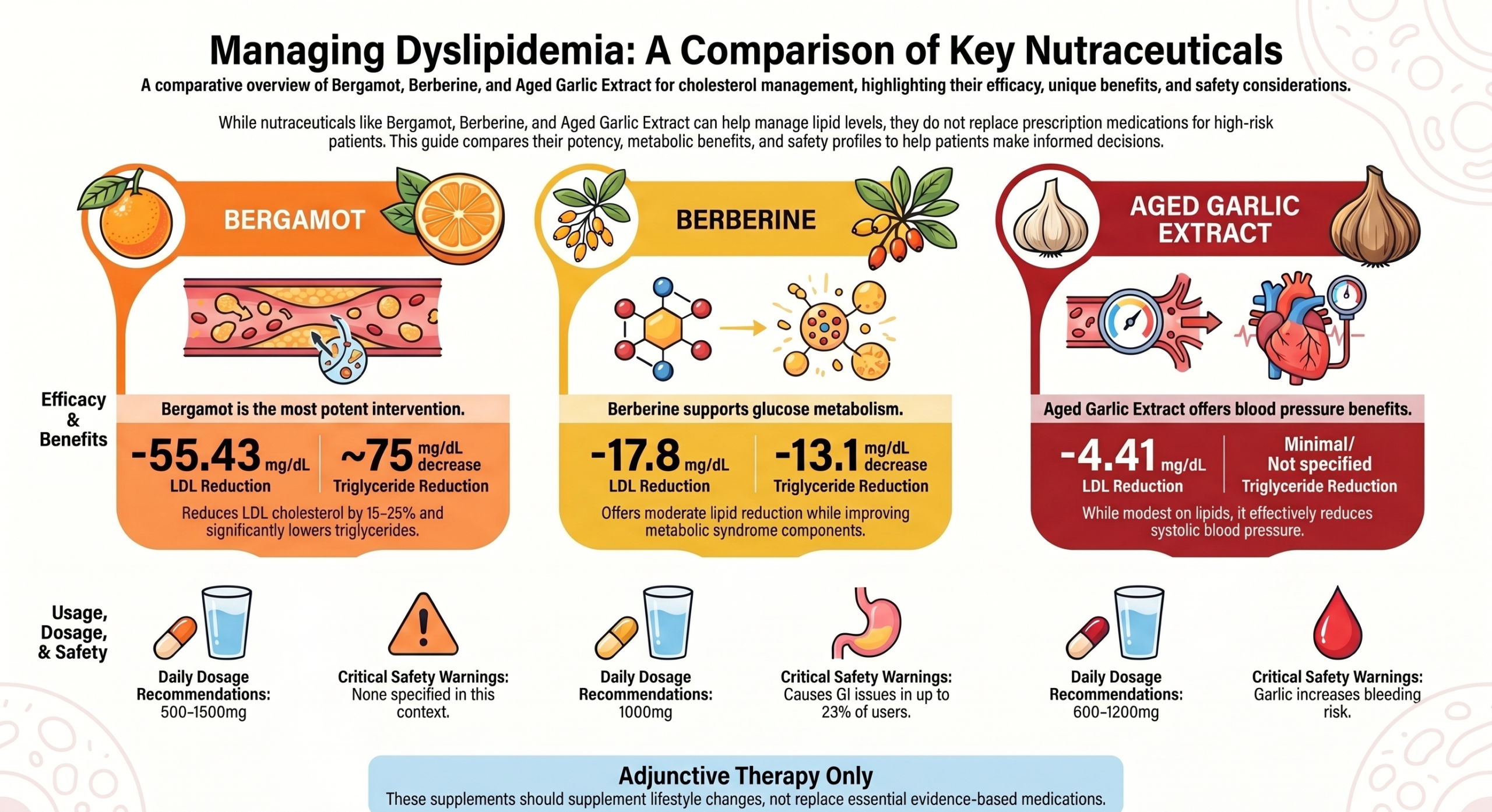
Three cholesterol-lowering supplements have the strongest clinical evidence: citrus bergamot (LDL reductions averaging 55 mg/dL in meta-analyses), berberine (LDL reductions of approximately 18 mg/dL), and aged garlic extract (modest LDL effects but meaningful cardioprotective benefits). The best choice depends on the underlying driver of your elevated cholesterol — bergamot for general dyslipidemia, berberine for insulin resistance, and aged garlic for oxidative burden and blood pressure support. This article explains the mechanisms, dosing, and when supplements alone are not enough.
Cholesterol-lowering supplements are one of the most common topics Dr. Regina Druz discusses with patients — both those who want to avoid statins and those already on medication who want to do more. Three supplements stand out for their clinical evidence: berberine, citrus bergamot, and aged garlic extract. Each works through a distinct mechanism, targets different aspects of the lipid panel, and carries a different risk profile. Understanding exactly how they differ — and which biomarkers they move most — is what turns a supplement into a tool rather than a gamble.
What Cholesterol Numbers Are We Actually Trying to Move?
When integrative cardiologists evaluate a lipid panel, the standard four-number summary — total cholesterol, LDL, HDL, triglycerides — is only the starting point. The metrics that predict cardiovascular risk with the most precision are:
- ApoB, LDL particle number (LDL-P) and small dense LDL: Small, dense LDL particles penetrate artery walls and oxidize far more readily than large, buoyant LDL — yet standard panels only report LDL concentration, not particle size or count.
- Non-HDL cholesterol: A more reliable surrogate for atherogenic particle burden than LDL alone, particularly in patients with elevated triglycerides.
- Triglyceride-to-HDL ratio: A ratio above 3.0 is a strong clinical signal for insulin resistance and metabolic dysfunction — the underlying driver in a large share of HHC patients.
- Lipoprotein(a) [Lp(a)]: Genetically determined and largely unresponsive to lifestyle — critical to measure because some supplements that lower LDL have no effect on Lp(a).
The supplements below are evaluated not just on total cholesterol reduction but on which of these markers they measurably improve.
| Supplement | LDL Reduction | Best For | Key Caution |
|---|---|---|---|
| Citrus Bergamot | ~55 mg/dL | General dyslipidemia, small dense LDL, visceral fat | No significant interactions identified |
| Berberine | ~18 mg/dL | Insulin resistance, metabolic syndrome, MASLD | CYP3A4 and P-glycoprotein drug interactions |
| Aged Garlic Extract | ~4 mg/dL | Oxidized LDL, borderline hypertension, CAC progression | Anticoagulant interaction, stop 10 days pre-surgery |
Lipid effects based on meta-analyses of randomized controlled trials. Individual response varies.
3 Natural Cholesterol-Lowering Supplements Backed by Clinical Evidence
1. Citrus Bergamot: The Most Potent of the Three
Citrus bergamot extract, derived from a citrus fruit grown primarily in Calabria, Italy, consistently produces the most significant lipid improvements in randomized controlled trials. Meta-analyses report LDL reductions of approximately 55 mg/dL, total cholesterol reductions of roughly 64 mg/dL, triglyceride reductions near 75 mg/dL, and HDL increases of about 6 mg/dL.
What makes bergamot clinically interesting beyond the headline numbers:
- AMPK activation: Bergamot’s flavonoids — neoeriocitrin, neohesperidin, and naringin — activate AMP-activated protein kinase (AMPK), a cellular energy sensor that suppresses hepatic cholesterol and triglyceride synthesis. This is the same pathway activated by metformin and berberine.
- Small dense LDL reduction: Unlike some cholesterol-lowering agents that reduce LDL concentration without improving particle quality, bergamot demonstrably shifts LDL particle distribution toward larger, less atherogenic particles.
- Visceral fat reduction: A 2021 RCT found bergamot phytosome reduced visceral fat alongside lipid improvements — relevant because visceral adiposity is an independent cardiovascular risk factor that standard lipid panels don’t capture.
- Safety profile: Bergamot has no significant drug interactions identified in current research and is the best-tolerated of the three supplements discussed here.
Clinical dosing: 500–1,500 mg daily; effects are dose-dependent and typically visible on a repeat lipid panel at 3 months.
2. Berberine: The Metabolic Supplement
Berberine is a plant alkaloid with a mechanism of action that partially overlaps with statins — but through a different pathway. It upregulates hepatic LDL receptor expression by inhibiting PCSK9, the protein that degrades LDL receptors. More LDL receptors means more LDL cleared from circulation.
Lipid effects from meta-analyses of RCTs:
- LDL reduction: approximately 18 mg/dL
- Total cholesterol reduction: approximately 18 mg/dL
- Triglyceride reduction: approximately 13 mg/dL
- HDL increase: approximately 2 mg/dL
Where berberine is particularly valuable is in the patient with concurrent metabolic dysfunction — elevated fasting glucose, insulin resistance, or diagnosed metabolic syndrome. A 2026 JAMA Network Open RCT found berberine reduced adiposity in individuals with obesity and metabolic dysfunction-associated steatotic liver disease (MASLD), independent of diet change. This makes it a logical first choice when elevated LDL and triglycerides are driven by insulin resistance rather than genetics.
Important caveat: Berberine inhibits CYP3A4 and P-glycoprotein, which can elevate plasma levels of drugs metabolized by these enzymes — including some statins, cyclosporine, and certain antihypertensives. A formal drug interaction review is required before initiating.
Clinical dosing: 500 mg twice daily with meals; start at 250 mg twice daily for 2 weeks to minimize GI adaptation effects.
3. Aged Garlic Extract: Modest Lipid Effects, Meaningful Cardioprotective Benefits
Aged garlic extract (AGE) occupies a different role than bergamot or berberine. Its direct lipid-lowering effect is modest — LDL reductions average approximately 4 mg/dL in meta-analyses — but this framing understates its cardiovascular utility.
What AGE does beyond the lipid panel:
- Antioxidant protection of LDL: S-allylcysteine (SAC), the primary bioactive compound in AGE, inhibits LDL oxidation. Oxidized LDL is the form that triggers foam cell formation and atherosclerotic plaque — measuring LDL concentration without assessing oxidation burden is an incomplete picture.
- Blood pressure reduction: A 2025 meta-analysis confirmed AGE reduces systolic blood pressure by approximately 2.5 mmHg — a meaningful contribution for patients managing borderline hypertension alongside elevated cholesterol.
- Coronary artery calcium: Pilot data suggests AGE may slow the progression of coronary artery calcium (CAC) scores — a direct measure of subclinical atherosclerosis and one of the evaluations included in the Step 1 Explore visit.
- Gut microbiome modulation: AGE favorably alters gut microbiota composition, with downstream effects on bile acid metabolism and systemic inflammation.
Precaution: AGE inhibits platelet aggregation. Patients on warfarin, aspirin, clopidogrel, or other anticoagulants must discuss timing and dose with their physician. Discontinue 10 days before elective surgery.
Clinical dosing: 600–1,200 mg daily in divided doses; 4–6 months for full lipid and antioxidant effect.
When to See a Doctor About Your Cholesterol
Supplements are appropriate tools for specific clinical situations — not a default response to any elevated cholesterol number. See a physician promptly if any of the following apply:
- Your LDL is above 190 mg/dL — this level typically indicates familial hypercholesterolemia, a genetic condition that requires medical management, not supplementation alone
- You have a 10-year cardiovascular risk above 7.5% — this is the evidence-based threshold for statin consideration, calculated using the Pooled Cohort Equations. Recently revised ACC/AHA guidelines on dyslipidemia (March 2026) use PREVENT equations with a lower risk threshold.
- You have diabetes, chronic kidney disease, or established heart disease — these conditions materially change the risk-benefit calculus for pharmacologic vs. supplement-based management
- You have been prescribed a statin and are stopping it without medical supervision — the decision to defer or discontinue statins carries measurable mortality risk in high-risk individuals
- Your triglycerides are above 500 mg/dL — at this level, the risk of pancreatitis supersedes the cholesterol conversation and requires immediate medical evaluation
- You have a family history of early heart attack or stroke (men under 55, women under 65 in a first-degree relative) — this changes your risk classification regardless of your current numbers
The Integrative Cardiology Approach to Cholesterol Management
Standard cardiovascular evaluation treats cholesterol as a billing code. As an integrative cardiologist, Dr. Regina Druz approaches it as a symptom — one that points to an upstream cause that a statin prescription does not address.
The testing that informs supplement selection at HHC goes beyond the standard four-number lipid panel:
- NMR LipoProfile or advanced lipid particle testing: Measures LDL particle number, small dense LDL concentration, and HDL particle quality — the metrics that determine whether a “normal” LDL is actually atherogenic.
- Lipoprotein(a) [Lp(a)]: Measured once; genetically fixed. Elevated Lp(a) changes both supplement strategy and the risk-benefit conversation around pharmacologic treatment.
- Fasting insulin and HOMA-IR: When insulin resistance drives the lipid phenotype, the therapeutic priority is metabolic — berberine becomes a stronger first choice than bergamot, and a carbohydrate-modified diet becomes non-negotiable.
- Highly sensitive CRP (hsCRP) and oxidized LDL: Inflammatory and oxidative burden influence which supplement mechanism is most clinically relevant. High oxidized LDL favors AGE’s antioxidant mechanism; high hsCRP may favor berberine’s anti-inflammatory properties.
- Thyroid panel (TSH, Free T4, Free T3, reverse T3): Hypothyroidism is the most commonly missed cause of elevated LDL in Dr. Druz’s patient population — a full thyroid panel, not just TSH, is required to rule it out.
- Coronary artery calcium (CAC) score: When any uncertainty exists about risk stratification, a CAC score directly quantifies subclinical atherosclerotic burden and changes the clinical conversation more reliably than a risk calculator alone.
The right supplement for elevated cholesterol is the one matched to the mechanism driving the elevation. Getting that answer requires more information than a standard annual panel provides.
Wondering which of these supplements is right for your lipid profile? The Step 1 Explore visit at Holistic Heart Centers includes a full review of your lipid panel, advanced biomarker testing, and a personalized supplement and lifestyle protocol from Dr. Druz. No guesswork, no generic recommendations.
Schedule a free call with our patient coordinator →
Frequently Asked Questions About Cholesterol-Lowering Supplements
What is the best natural supplement to lower cholesterol?
Citrus bergamot produces the largest reductions in published RCTs — LDL reductions averaging approximately 55 mg/dL and total cholesterol reductions near 64 mg/dL, with an excellent safety profile and no significant drug interactions identified to date. That said, the best supplement depends on the mechanism driving your elevated cholesterol. Patients with insulin resistance or metabolic syndrome often respond better to berberine, which targets PCSK9 inhibition and improves blood sugar simultaneously. A complete lipid evaluation — including particle size, fasting insulin, and inflammation markers — is the most reliable way to match the supplement to the cause. Understanding your cardiac risk using our Heartwell.AI provides a path to simulate the impact of medications and supplements based on your own lab data-opening the door to a precision heart health approach.
Does berberine actually lower cholesterol?
Yes. Multiple meta-analyses of randomized controlled trials confirm berberine reduces LDL by approximately 18 mg/dL, total cholesterol by approximately 18 mg/dL, and triglycerides by approximately 13 mg/dL. It works by inhibiting PCSK9 — the same protein targeted by the most potent class of prescription cholesterol drugs — which increases hepatic LDL receptor expression and clears more LDL from the bloodstream. The effects are clinically meaningful, particularly in patients with concurrent metabolic dysfunction. Berberine interacts with CYP3A4 and P-glycoprotein, so a drug interaction review is required before starting it alongside other medications.
Can I take berberine and bergamot together?
There is no published evidence that combining berberine and bergamot is unsafe, and the two work through complementary mechanisms — PCSK9 inhibition (berberine) and AMPK activation (bergamot). In practice, Dr. Druz recommends identifying which mechanism is most relevant to your specific atherogenic lipid phenotype (ALP) before stacking supplements. Adding both increases cost and pill burden without necessarily producing additive results unless the underlying drivers warrant both mechanisms. A baseline lipid panel with advanced markers — LDL particle number, oxidized LDL, fasting insulin — makes this decision considerably more precise.
How long does it take for cholesterol supplements to work?
Expect 2–3 months before a meaningful change appears on a repeat lipid panel, and 4–6 months for full effect. This timeline applies to all three supplements discussed here. Recheck cholesterol at 3 months minimum after starting any supplement — testing at 4–6 weeks is too early to draw conclusions and frequently leads to premature discontinuation. Timeline varies depending on baseline lipid levels, adherence to dosing, and whether dietary and lifestyle factors are being addressed concurrently.
Are cholesterol-lowering supplements safe to take with statins?
Bergamot has the most favorable safety profile for use alongside statins — no significant pharmacokinetic interactions have been identified. Berberine requires caution because it inhibits CYP3A4, the enzyme that metabolizes several statins including simvastatin and lovastatin; this combination can increase statin plasma levels and the risk of myopathy. Aged garlic extract does not interact with statins directly but potentiates anticoagulant effects if the patient is also on aspirin or blood thinners. All three should be discussed with your prescribing physician before adding them to a statin regimen.
Can supplements replace statins for high cholesterol?
Not for patients at high cardiovascular risk. Statins have decades of randomized trial evidence demonstrating reduced rates of heart attack, stroke, and cardiovascular death in patients with established heart disease, diabetes, or a 10-year cardiovascular risk above 7.5%. Supplements improve lipid numbers but have not been studied for hard outcomes at scale. For patients with mildly elevated cholesterol, no established cardiovascular disease, and a preference for non-pharmacologic management, supplements alongside dietary changes represent a reasonable first step — but this decision requires risk stratification, not just a cholesterol number.